
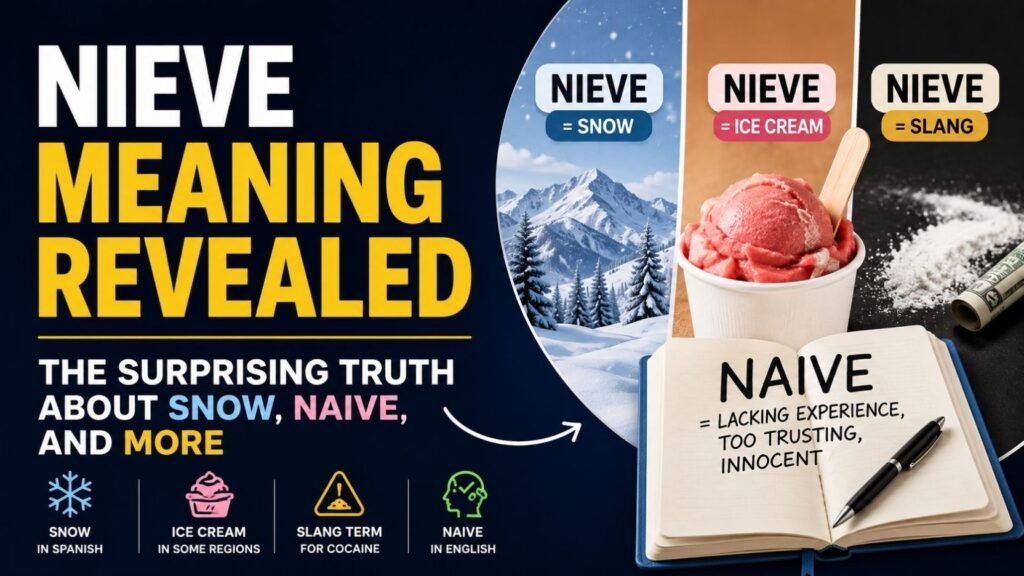
Nieve means snow in Spanish, and depending on the region, it can also mean a fruit flavored ice or sorbet, or a slang term for cocaine. If you landed here because you typed “nieve meaning” but you were actually thinking of the English word for someone innocent, trusting, or a little too easily fooled, you were probably looking for naive, not nieve. Both confusions are common, and this guide clears up all of them with verified definitions, pronunciation, and real examples.
Quick Answer Box
| Term | Language | Core Meaning | Common Trap |
| Nieve | Spanish | Snow | Confused with the English word naive |
| Nieve (regional) | Spanish, Mexico and parts of Latin America | Flavored ice, sorbet, or ice cream | Mistaken for a typo of nieve meaning snow |
| Nieve (slang) | Spanish, informal | Cocaine | Overlooked in dictionary searches |
| Naive | English | Lacking experience, overly trusting, innocent in judgment | Misspelled as nieve |
| Nieves | Spanish | Plural of nieve, or a surname and given name | Confused with the singular word |
What Does Nieve Mean In Spanish?
In standard Spanish, nieve is a feminine noun that simply means snow, the soft white frozen precipitation that falls in cold weather. It comes from the Latin word nix, nivis, which carried the same meaning centuries ago. You will hear it in ordinary weather talk, in phrases like “está nevando” (it is snowing) and “cayó mucha nieve anoche” (a lot of snow fell last night), and in compound expressions that Spanish speakers use every day.
Because Spanish is spoken across so many countries, nieve has picked up a few extra meanings along the way. Knowing which one applies depends entirely on context and region, which is exactly why so many people end up confused when they search for this word online.
Common phrases that use nieve:
- Copo de nieve: snowflake
- Bola de nieve: snowball
- Muñeco de nieve: snowman
- Tormenta de nieve: snowstorm
- Blanco como la nieve: white as snow
- Moto de nieve: snowmobile
Note: Spelling matters here. Nieve (three syllables, ending in -e) is the Spanish word for snow. It has no direct relationship to the English word naive, even though the two look and sound similar enough to trip people up in a Google search bar.
See More: FG Meaning In Text
Nieve Meaning Ice Cream: The Regional Twist
If you searched “nieve meaning ice cream,” you are not imagining things. In Mexico and several other Latin American countries, nieve also refers to a frozen dessert, closer to a sorbet or Italian ice than to traditional dairy ice cream. Street vendors and small shops known as neverías sell nieve in fruit flavors like mango, tamarind, and coconut, and the texture is typically lighter and less creamy than what Americans think of as ice cream.
This regional meaning exists alongside the weather meaning, and Spanish speakers rely on context to know which one is meant. Nobody orders “a scoop of snow” and nobody complains about “ice cream falling on the road,” so the sentence around the word almost always makes the intended meaning obvious.
Quick Tip:
If you see nieve on a restaurant menu or a street cart in Mexico, it almost certainly refers to the frozen dessert, not the weather.
Nieve As Slang: What You Should Know
Nieve is also used informally in Spanish as a slang term for cocaine, in the same way English speakers sometimes use the word “snow” for the same drug. This usage shows up in music, film, and colloquial conversation, and dictionaries such as Cambridge and Collins both confirm it as an established secondary meaning of the word.
It is worth knowing this meaning exists so that context in song lyrics, subtitles, or informal speech makes sense, even though it is not the primary or most common use of the word.
Naive Or Nieve: Which Spelling Is Correct in English
If your intended meaning was about a person being innocent, inexperienced, or too trusting, the correct English word is naive, not nieve. This is one of the most common misspellings in English, and it happens because the two words sound somewhat alike when spoken quickly, and because “ie” and “ei” letter combinations are notoriously easy to mix up.
According to Merriam-Webster, naive is defined as marked by innocence or simplicity, lacking sophistication, or showing a lack of experience or judgment, especially in a way that makes someone easily deceived. The word entered English from French naïve, the feminine form of naïf, which traces back to the Latin nativus, meaning native or natural. That Latin root is also where the English word “native” comes from, so naive and native are etymological cousins.
Example sentences using naive correctly:
- It was naive of him to think the deal had no risk attached.
- She gave a naive answer that revealed she had never negotiated a contract before.
- We naively believed the repairs would only take one afternoon.
How To Spell Naive: A Simple Memory Trick
People search “how to spell nieve meaning innocent” often enough that it is worth addressing directly. The word you want is spelled n a i v e, and it is frequently written with a diaeresis over the i as naïve, though the plain spelling without the accent mark is standard and accepted in American English.
A simple way to remember the spelling is to connect naive to native, since both words share the same Latin root nativus. If you can spell native, you already know the letter pattern that naive follows, just with an extra a at the front.
Warning:
Autocorrect on some phones and browsers can turn naive into nieve if you type quickly or misspell it slightly, since nieve is a recognized word in Spanish dictionaries that many keyboards support. Always double-check before hitting send on anything formal.
See More: What Does IGH Mean In Text
Nieve Meaning Dumb Or Foolish: Is That Accurate
Some searchers look up “nieve meaning dumb” or “nieve foolish,” which suggests they are actually trying to describe the English concept of naivety using the wrong spelling. Naive does not mean unintelligent, and this distinction matters. A naive person may be perfectly smart but simply inexperienced, overly trusting, or unaware of how a particular situation actually works. Calling someone naive is a comment on judgment shaped by limited experience, not a comment on their intelligence.
This distinction is worth remembering because using naive as an insult about intelligence misses the actual definition and can come across as unfair or inaccurate in professional or academic writing.
Nieve Meaning In English: Synonyms And Related Words
When people search “nieve meaning english synonyms,” they are typically looking for words related to naive. According to the Merriam-Webster Thesaurus, common synonyms include artless, ingenuous, natural, and unsophisticated, all of which describe a lack of pretension or calculation, though each carries a slightly different shade of meaning.
Synonyms for naive:
- Innocent
- Ingenuous
- Unworldly
- Credulous
- Inexperienced
- Trusting
- Green (informal)
Words that mean the opposite:
- Sophisticated
- Worldly
- Cynical
- Savvy
- Streetwise
Nieve as a Name: Nieves And Its Meaning
Nieves is the plural form of nieve in Spanish, and it also functions as a given name and surname across the Spanish speaking world. According to genealogical and naming sources, Nieves derives from the religious title Nuestra Señora de las Nieves, or Our Lady of the Snows, a reference to a fourth-century account of summertime snowfall in Rome that led to the founding of the Basilica of Saint Mary Major. Because of this origin, Nieves carries a devotional, historic meaning tied to Catholic tradition in Spain and Latin America, and it remains a common name for women today.
If you searched “nieves de enero meaning” or “nieves de enero song meaning” while researching this topic, you were likely looking for an interpretation of specific song lyrics rather than a dictionary definition. Song titles and lyrics often use nieve or nieves poetically, drawing on the imagery of snow, purity, or the passage of time, and their exact meaning depends on the individual songwriter’s intent rather than a fixed dictionary entry.
La Nieve, De Nieve And Other Common Phrases
Searches like “la nieve meaning,” “de nieve meaning,” and “chica de nieve meaning” are usually people encountering the word inside a larger Spanish phrase or song lyric and wanting a translation. La nieve simply means “the snow,” using the feminine definite article la that pairs with the feminine noun nieve.
De nieve translates to “of snow” and appears in compound phrases such as copo de nieve (snowflake) or muñeco de nieve (snowman). Chica de nieve translates literally to “snow girl,” a phrase that shows up in song titles and poetic Spanish without a single fixed cultural meaning beyond its literal translation.
Nieve In Spanish vs Nieve In Urdu Searches
A smaller group of searchers look up “nieve meaning in urdu,” which typically reflects someone encountering the Spanish word in media, translating a name, or trying to find an equivalent term in Urdu.
Since nieve is a Spanish word for snow, the accurate translation into Urdu would simply be the Urdu word for snow, برف (barf), rather than a direct loanword, since nieve itself has not been adopted into Urdu vocabulary.
See More: What Does !! Mean?
Frequently Asked Questions
What does nieve mean in English?
Nieve is a Spanish word that means snow in English. Regionally, it can also mean flavored ice or, informally, cocaine.
Is nieve the correct spelling of naive?
No. Naive is the correct English spelling for the word meaning innocent or inexperienced. Nieve is an unrelated Spanish word.
Does nieve mean stupid or dumb?
No. Nieve means snow in Spanish, and even the related English word naive does not mean unintelligent, only inexperienced or overly trusting.
How do you pronounce nieve in Spanish?
Nieve is pronounced nee EH veh, with three clear syllables, unlike the two syllable English word naive.
What is nieve meaning ice cream?
In Mexico and other Latin American countries, nieve refers to a fruit flavored frozen dessert similar to sorbet, sold at small shops called neverías.
Is nieve a name?
Yes, both Nieve and its plural Nieves are used as given names and surnames, originating from a Catholic title referring to Our Lady of the Snows.
What language is nieve from?
Nieve is a Spanish word that developed from the Latin term nix, nivis, which also meant snow.
Why do people confuse nieve and naive?
The two words share similar sounds and letter patterns, and autocorrect tools sometimes swap one for the other, leading to frequent spelling confusion online.
What is the Oxford definition of naive?
Oxford dictionaries define naive as showing a lack of experience, wisdom, or judgment, often marked by excessive trust or simplicity.
Can nieve mean cocaine?
Yes, nieve is used informally in Spanish as slang for cocaine, similar to how “snow” is used in English slang, and this usage appears in dictionaries such as Cambridge and Collins.
Conclusion
Nieve and naive look similar but come from completely different languages and mean completely different things. Nieve is Spanish for snow, with regional meanings tied to flavored ice and, informally, a slang term for a drug, while naive is the correct English spelling for describing someone innocent, inexperienced, or too quick to trust.
The next time you are unsure which one you need, remember that nieve falls from the sky in a Spanish speaking country, while naive describes a person’s judgment in English, and you will never mix the two up again.

Sana Saleem is the author of Meanz Vault, dedicated to researching and writing about word meanings, slang meanings, name meanings and language. With 4 years of experience, his aim is to provide clear, accurate, and easy-to-understand information that helps readers discover the meaning behind words, phrases, and names.