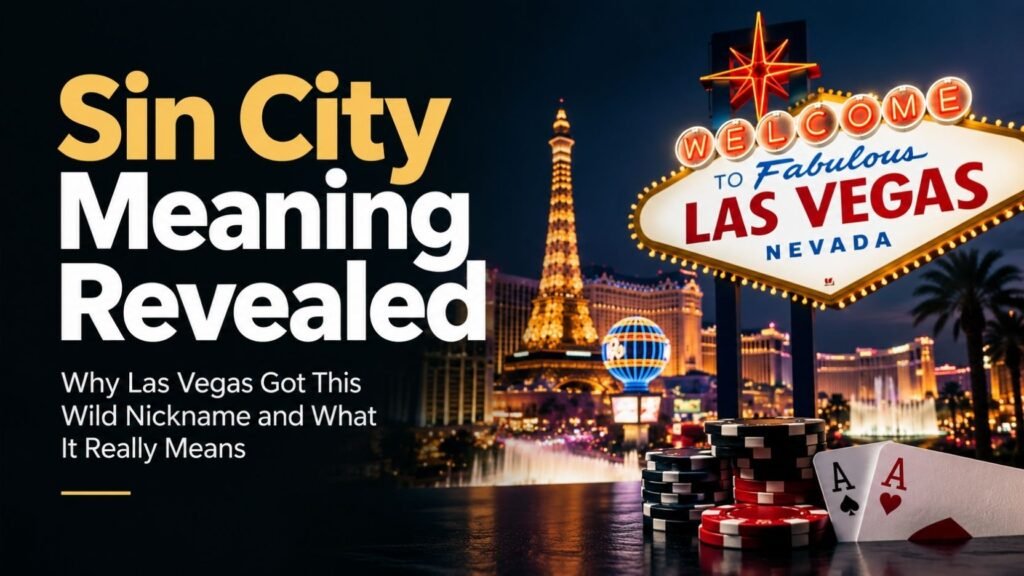
Sin City meaning, in plain terms, refers to a nickname for a place known for gambling, nightlife, and indulgence, and it is most famously attached to Las Vegas, Nevada. The name grew out of a real red light and gambling district that operated openly in the early 1900s. Today it works as both a literal description of Las Vegas history and a general slang term for any city where vice runs loose.
If you searched for this phrase, you probably want more than a one line definition. You want to know where it came from, whether it is still accurate, how it shows up in music and movies, and how people use it in everyday conversation. This guide covers all of that, using only verified historical sources, dictionaries, and reputable reporting, so you walk away with the full picture instead of half a story.
Quick Definition: What Does Sin City Mean
Before going into the history, here is the short answer that most searchers actually need.
Sin City (noun): A common nickname for Las Vegas, Nevada, used to describe a city associated with gambling, drinking, adult entertainment, and other activities traditionally viewed as vices. More generally, the term can describe any city or district that has earned a reputation as a hotbed of vice. According to Wiktionary’s dictionary entry, this is the primary slang definition still in active use today.
Quick Facts
| Detail | Information |
| Most common meaning | Las Vegas, Nevada |
| Part of speech | Proper noun (nickname) or common noun (general term) |
| Word type | Slang, informal |
| Earliest generic use | By 1940, in advertising for the film Destry Rides Again |
| Earliest Las Vegas specific use | Associated with Las Vegas from around 1960 onward |
| Also historically used for | Montreal, Phenix City (Alabama), Calumet City (Illinois), Baghdad, and several other towns |
| Related phrase | “What happens in Vegas, stays in Vegas” |
Sin City Meaning in Simple English
In plain English, calling a place “Sin City” means people believe that city makes it unusually easy, and sometimes unusually acceptable, to do things considered sinful or reckless. Gambling away your paycheck, drinking past midnight, visiting a strip club, or getting a same day wedding in a drive through chapel all fit the theme. The word “sin” here is not really about religious doctrine most of the time. It is shorthand for indulgence, temptation, and a loosening of the everyday rules people follow at home.
That is why the phrase works so well as a nickname rather than an insult in most contexts. Las Vegas itself leans into the label in tourism marketing, because visitors associate it with freedom from routine rather than genuine wrongdoing. A teenager asking “what does sin city mean” in a text thread is usually just asking why everyone calls Vegas that. The honest answer is history, marketing, and a reputation that has been reinforced for more than a century.
Why Is Las Vegas Called Sin City? The Real History
This is the question most people actually came here to answer, so it deserves a proper walk through the history rather than a guess.
Block 16 and Block 17: The Original Vice District
Las Vegas began as a railroad water stop in the Nevada desert, and the name itself comes from Spanish, where “las vegas” means “the meadows,” a reference to the natural springs that once watered the area. When the San Pedro, Los Angeles and Salt Lake Railroad auctioned off the townsite in 1905, city planners set aside a specific downtown block for saloons and gambling. That block, later joined by a neighboring one, became known as Block 16 and Block 17.
According to historical accounts reported by Las Vegas news outlets, these two blocks on First Street between Ogden and Stewart avenues grew into a cluster of saloons, gambling halls, and brothels operating in the open. The Arizona Club, one of the most notorious establishments, reportedly built a second floor specifically so that sex workers could rent rooms above the saloon. Nevada actually banned gambling statewide in 1910, yet illegal casinos in this district kept running underground until the state relegalized gambling in 1931.
This is the part of the story most local historians point to as the true root of the nickname. Even the Las Vegas Sun and other regional publications have traced the phrase “Sin City” back to this specific stretch of downtown rather than to the Strip that tourists picture today. So when someone asks about the Las Vegas Sin City meaning specifically, the honest answer starts in this two block red light district, not in the neon towers built decades later.
The Mob Era and How It Deepened the Reputation
Organized crime money helped build much of the early Las Vegas Strip in the mid twentieth century, and that financial involvement brought skimming operations, money laundering, and a national reputation for corruption along with it. Stories about mob financiers and behind the scenes power struggles became part of the city’s mythology, and The Mob Museum in downtown Las Vegas now documents this era extensively for the public record. Several early casino resorts had confirmed ties to organized crime figures, a fact well established in historical archives rather than rumor.
At the same time, Nevada’s unusually lenient residency laws made the state a national destination for quick marriages and even quicker divorces, according to records held by the Nevada State Library, Archives and Public Records. People were not simply visiting Las Vegas for a weekend. Many were using it to escape a marriage, a debt, or a routine life back home, and that pattern reinforced the sense that the city operated by different rules. The mob era eventually ended through federal pressure and corporate takeovers, but the reputation it built into the city’s identity never fully went away.
When “Sin City” Became a Published Nickname
Although the behaviors tied to the name existed for decades, one of the earliest documented uses of the phrase in print appeared in the 1963 book Las Vegas, City of Sin? by Dick Taylor and Pat Howell. Language researchers at the Online Etymology Dictionary note that the general phrase “Sin City,” used for any hotbed of vice, actually predates that book by roughly two decades, appearing in advertising for the 1940 film Destry Rides Again, in which the fictional Wild West town was billed as a sin city of the Old West. The connection specifically to Las Vegas as a real place solidified in reporting from around 1960 onward.
By the time tourism expanded through the 1960s and 1970s, the nickname had become such reliable shorthand that Las Vegas stopped fighting it and started marketing around it instead. This matters for anyone trying to understand the timeline: the vice existed first, the generic slang term existed second, and the specific pairing of the phrase with Las Vegas came together as public perception caught up with both.
Where the General Term “Sin City” Actually Comes From
Here is something most articles on this topic skip entirely, and it is one of the more interesting facts once you dig into language history. “Sin City” was not invented for Las Vegas. It started as a generic English phrase for any community considered a hotbed of vice, and it got attached to a long list of American towns before it settled permanently on Las Vegas.
Etymology research from the Online Etymology Dictionary documents that in the years following its 1940 debut in movie advertising, newspapers and headline writers applied “Sin City” to numerous real places, almost as a stock phrase for scandal reporting. Some of the towns that carried the label at various points include:
- Lavallette, New Jersey, in earlier movie ad headline use
- Baghdad, referenced this way in both 1950 and again in 1953
- Great Falls, Montana, in 1952
- A strip in suburban Calumet City, outside Chicago, in 1953
- Odessa, Texas, in 1953, describing conditions from a few years earlier
- Phenix City, Alabama, repeatedly through 1953 and 1954, tied to a well documented vice and corruption scandal there
Note: The Oxford English Dictionary separately records its earliest confirmed print citation for the specific noun phrase “sin city” from a 1973 article in The Guardian, which reflects how long it took formal dictionaries to catch up with slang that newspapers had already been using for decades.
The dictionary and reference site YourDictionary also notes a second, more surprising historical use: during the prohibition era, “Sin City” or “Sin Cité” was a nickname applied to Montreal, Quebec, because Canadian liquor laws were far looser than American ones at the time, drawing American visitors north for legal drinking. So while Las Vegas has clearly won the branding war today, it was competing with a genuine list of contenders throughout the twentieth century.
Sin City Meaning in Slang and Everyday Use
In casual conversation and slang usage, “sin city” almost always defaults to meaning Las Vegas unless the context makes clear otherwise. People use it as a stand in for the whole city, the way “the Big Apple” stands in for New York or “the Windy City” stands in for Chicago. You will hear it in phrases like a bachelor party heading to Sin City for the weekend, or a headline describing a wild night out in Sin City.
The tone of the slang matters too, and it usually is not meant as a genuine moral judgment. Most speakers use it affectionately, the same way someone might call a messy apartment a “disaster zone” without actually being upset about it. Search platforms like Urban Dictionary host user submitted definitions that lean into this playful tone, often describing Sin City through pop culture references such as Frank Miller’s graphic novels rather than religious language. In everyday texting or casual writing, if you see “sin city meaning” used as a question, the person asking is almost always asking about Las Vegas specifically, not requesting a theological explanation of sin.
Quick Tip: If you are writing for an international audience and want to avoid confusion, it helps to say “Las Vegas, nicknamed Sin City” on first mention. Readers outside North America do not always know the nickname automatically, even though the phrase is common in English language slang.
Is Las Vegas Still Called Sin City Today?
Yes, Las Vegas is still widely called Sin City, and recent data suggests the label still fits by several measurable standards, not just by reputation. WalletHub’s 2025 ranking of the most sinful cities in America, which compared more than 180 U.S. cities across 37 indicators covering categories like greed, lust, vanity, and excess, placed Las Vegas at number one overall. The city ranked first in the country for casinos per capita among the study’s greed related metrics and first for adult entertainment establishments per capita in the lust category.
That said, modern Las Vegas offers far more than its nickname implies, and treating it as purely a den of vice misses a lot of what the city actually is today. The Strip now includes major shopping districts, celebrity chef restaurants, professional sports franchises including the NHL’s Golden Knights and NFL’s Raiders, botanical gardens, and family oriented attractions that did not exist a generation ago. Longtime residents, according to local news reporting from Nevada outlets, often say they dislike the nickname because it flattens an entire metro area of over two million people into a single stereotype built around a small historic district and a strip built for tourists.
Table: Sin City Reputation, Then and Now
| Category | Early 1900s Las Vegas | Modern Las Vegas |
| Center of activity | Block 16 and Block 17 downtown | The Strip and downtown Fremont Street |
| Legal status of gambling | Banned 1910, relegalized 1931 | Fully legal and regulated statewide |
| Dominant industries | Saloons, brothels, illegal gambling | Tourism, conventions, entertainment, sports, hospitality |
| Organized crime presence | Growing through mid century | Largely eliminated through federal enforcement and corporate ownership |
| Public image | Frontier vice town | Global entertainment capital that still markets its wild side |
Sin City Meaning in Pop Culture
The phrase has traveled far beyond travel writing and local history, showing up repeatedly in music, film, and literature, which is part of why it stays so recognizable across generations.
Frank Miller’s Sin City Comics and Films
“Sin City” is also the title of a series of graphic novels created by writer and artist Frank Miller, first published starting in the 1990s and set in a fictional, crime ridden metropolis called Basin City, nicknamed Sin City by its residents. The comics were adapted into the 2005 film Sin City, co-directed by Robert Rodriguez and Miller, followed by a 2014 sequel, Sin City: A Dame to Kill For. This fictional universe is dark, violent noir fiction, and it is a completely separate creative work from the real city nickname, even though both share the same evocative name and neon soaked visual style.
AC/DC’s “Sin City”
Australian rock band AC/DC released a track called “Sin City” on their 1978 album Powerage, with vocals from Bon Scott and songwriting credited to Angus Young, Malcolm Young, and Scott. According to analysis from Rolling Stone Australia, the song paints a picture of the fortunes and excesses that await big winners in a high stakes gambling town, while also acknowledging how the odds are stacked against the average gambler. It remains one of the more enduring rock references to the sin city concept, built around themes of luck, wealth, and risk rather than a literal travelogue of Las Vegas.
Gram Parsons and the Flying Burrito Brothers
Gram Parsons, a pioneering figure in country rock, co-wrote a song titled “Sin City” that appeared on the Flying Burrito Brothers’ 1969 debut album, The Gilded Palace of Sin. The song is widely regarded by music historians as a commentary on excess and moral decline, often interpreted as pointed at Los Angeles rather than Las Vegas specifically, which is a useful reminder that the phrase has never belonged exclusively to one city in songwriting.
“What Happens in Vegas, Stays in Vegas”
No discussion of Sin City culture is complete without this slogan, which grew out of a Las Vegas Convention and Visitors Authority advertising campaign in the early 2000s. The phrase leaned directly into the city’s existing Sin City reputation and turned it into an invitation rather than a warning, encouraging visitors to indulge without consequence. It became so culturally embedded that it inspired the 2008 comedy film What Happens in Vegas and is still used today, often jokingly, whenever someone wants to describe behavior meant to stay private.
Other Cities Called “Sin City” Around the World
Las Vegas may be the most famous holder of the title, but it is far from the only city that travel writers and locals associate with the same reputation. None of these labels are official designations; they reflect popular perception, tourism marketing, and media coverage rather than any formal ranking body.
Comparison Table: Global Cities Known for a “Sin City” Reputation
| City | Country | Reputation Built Around |
| Las Vegas | United States | Legal gambling, adult entertainment, 24 hour nightlife |
| Macau | China (Special Administrative Region) | The world’s largest gross gaming revenue market, far exceeding the Las Vegas Strip |
| Pattaya | Thailand | Beach resort nightlife, bars, and a large adult entertainment scene |
| Amsterdam | Netherlands | Legal regulated red light district and liberal drug and nightlife policy |
| Tijuana | Mexico | Nightlife along Avenida Revolución and a legally permitted red light district |
| Bangkok | Thailand | Nightlife districts, entertainment venues, and a reputation as a party destination |
Where is “Sin City” in Thailand? People searching for a sin city in Thailand are usually asking about Pattaya, a coastal resort city roughly two hours from Bangkok that has built much of its tourism economy around nightlife, bars, and adult entertainment. Bangkok itself also carries a version of the reputation, driven by its own nightlife districts, though Pattaya is more consistently the city travel writers single out first.
Where is “Sin City” in Europe? Amsterdam is the city most consistently labeled the sin city of Europe, largely because of its legally regulated red light district and comparatively liberal drug policy, both of which set it apart from most other major European capitals. This is a reputation built on formal regulation rather than the underground, unofficial vice districts that shaped early Las Vegas.
Note: Macau deserves a special mention here because the numbers are genuinely striking. Macau’s gambling industry generates gross gaming revenue that has been reported at multiple times the size of the entire Las Vegas Strip’s casino revenue, driven largely by high stakes visitors from mainland China and elsewhere in Asia. Despite that scale, Macau rarely overtakes Las Vegas in casual English language slang, mostly because “Sin City” became linguistically locked to Las Vegas decades before Macau’s casino boom took off in the 2000s.
The Most Sinful Cities in America Right Now
Beyond the historical nickname, there is actual data measuring which American cities behave the most like a modern “sin city.” WalletHub, a personal finance research site, published its most recent Most Sinful Cities in America report using data collected as of October 2025, comparing 182 cities across seven categories: anger and hatred, jealousy, excesses and vices, greed, lust, vanity, and laziness.
Top 10 Most Sinful Cities in America (WalletHub, 2025 Data)
| Rank | City | WalletHub Vice Index Score |
| 1 | Las Vegas, NV | 61.94 |
| 2 | Houston, TX | 58.30 |
| 3 | Los Angeles, CA | 54.93 |
| 4 | Philadelphia, PA | 54.11 |
| 5 | Atlanta, GA | 52.87 |
| 6 | Denver, CO | 52.62 |
| 7 | Miami, FL | 52.29 |
| 8 | Dallas, TX | 51.48 |
| 9 | Phoenix, AZ | 51.27 |
| 10 | New Orleans, LA | 50.71 |
According to WalletHub’s own analysis, Las Vegas topped the list largely because of its casino density, its ranking as the American city with the most adult entertainment establishments per capita, and unusually high search interest in topics like plastic surgery, strip clubs, and extramarital affairs. Houston came in second, driven by a mix of adult entertainment density, violent crime indicators, and gambling related problems, while Los Angeles ranked third due to a combination of school bullying rates, hate crime statistics, and low charitable giving relative to income.
Why does this matter for the Sin City meaning discussion? It shows the nickname is not just an old story about a red light district that closed decades ago. By measurable, current standards using government and industry data, Las Vegas genuinely still leads the country in the categories that built its reputation in the first place, which is part of why the label has stuck for more than a century instead of fading out.
Sin City Meaning in Hindi, Bengali, and Other Languages
Many people around the world encounter the phrase “Sin City” through English language media, movies, and news coverage before ever learning its backstory, which is why searches for the meaning in specific languages are common. Rather than translating the nickname literally, most language resources explain it as a description, since “Sin City” functions as a proper noun nickname for Las Vegas rather than a phrase that maps neatly onto every language’s vocabulary for sin.
According to the multilingual Reverso Dictionary, common ways the concept is rendered in translation include the following.
| Language | Common Translation or Explanation |
| Hindi | Rendered as “Sin City” (transliterated) or explained descriptively as “the city of sin” |
| Bengali | Rendered as “Sin City” (transliterated) or explained descriptively as “the city of sin” |
| Spanish | “Ciudad del pecado,” meaning “city of sin” |
| French | “Ville du vice,” meaning “city of vice” |
| German | “Stadt der Sünde,” meaning “city of sin” |
Note: For languages including Urdu, Telugu, and Malayalam, there is no single standardized dictionary translation of “Sin City” the way there is for major European languages, since it functions primarily as an English language nickname for a specific American city rather than a universal idiom. In practice, most speakers of these languages either keep the English name “Sin City” as a loanword or simply describe Las Vegas as a city known for gambling and nightlife when explaining the term to someone unfamiliar with it. If you are translating content professionally, it is safer to explain the concept descriptively than to force a literal word for word translation.
Conculsion
The Sin City meaning boils down to a nickname built from real history rather than pure marketing invention. A two block red light district in early 1900s Las Vegas, later reinforced by organized crime money and a national reputation for quick vice and quick escape, earned the city a label that stuck for more than a hundred years. The phrase existed before Las Vegas claimed it, has been loaned to other cities from Macau to Amsterdam, and even inspired an entirely separate fictional universe in Frank Miller’s comics and films.
What makes the story worth knowing is that the label still holds up by modern, measurable standards, not just old newspaper clippings. Whether you came here to settle a trivia question, understand a song lyric reference, or just figure out why your friend keeps calling their upcoming Vegas trip a visit to Sin City, the answer traces back to the same downtown blocks, the same mid century mob history, and the same reputation Las Vegas has never really tried to shake off.
Sin City Meaning: Frequently Asked Questions
What does Sin City mean?
Sin City is a nickname, most commonly used for Las Vegas, describing a place known for gambling, drinking, and other activities traditionally considered vices.
Why is Las Vegas called Sin City?
Its downtown red light and gambling district, known as Block 16 and Block 17, operated openly from the early 1900s, and organized crime later deepened that reputation.
Is Sin City only used for Las Vegas?
No. It started as a generic term applied to many towns before the 1960s, and it is still used today for Macau, Pattaya, Amsterdam, and other cities.
Is Sin City a compliment or an insult?
It is usually neither. Most people use it affectionately or descriptively, though some longtime Las Vegas residents dislike the label because it oversimplifies their home city.
What is Sin City in the Frank Miller comics?
It is a fictional crime city called Basin City, nicknamed Sin City, created for Frank Miller’s graphic novels and later adapted into two feature films.
Which city is the sin city of Thailand?
Pattaya holds that reputation most consistently, due to its beach resort nightlife and large adult entertainment industry, though Bangkok is sometimes included too.
Which city is the sin city of Europe?
Amsterdam is usually given that title because of its legally regulated red light district and comparatively liberal drug and nightlife laws.
Is Las Vegas actually the most sinful city in America today?
According to WalletHub’s 2025 data ranking 182 U.S. cities across vice related indicators, Las Vegas currently ranks number one overall.
What does “what happens in Vegas, stays in Vegas” mean?
It is a marketing slogan from the early 2000s built on the Sin City reputation, encouraging visitors to indulge without consequences following them home.
Does Urban Dictionary define Sin City differently than formal dictionaries?
Not fundamentally. Urban Dictionary entries still center on Las Vegas and the Frank Miller comics, though the tone is more casual and pop culture focused than a formal dictionary entry.

Sana Saleem is the author of Meanz Vault, dedicated to researching and writing about word meanings, slang meanings, name meanings and language. With 4 years of experience, his aim is to provide clear, accurate, and easy-to-understand information that helps readers discover the meaning behind words, phrases, and names.