
Quick Answer
The key to the city meaning comes down to one simple idea: it is a ceremonial, non-functional award that a mayor or city council gives to someone the city wants to honor, thank, or welcome. It does not open any door, and it carries no legal power. A key to the city is a ceremonial honor with no legal force whatsoever, and it does not unlock any doors, grant access to city buildings, or come with parking privileges, transit passes, or tax breaks.The gesture traces back centuries, and it survives today as a way for a community to say, in a very public and memorable fashion, that someone has earned its trust and gratitude.
That short definition answers the search query, but it barely scratches the surface of a tradition with real depth. Below, you will find the full history of the honor, how modern cities actually decide who receives one, what happens at the ceremony itself, and how the phrase has drifted into slang, pop culture, and even superhero movies. Every claim here is drawn from verifiable sources, including city government pages, historical archives, and recent news coverage, so you can trust what you read.
See More: Sin City Meaning Revealed
What Does Key to the City Mean, Exactly?
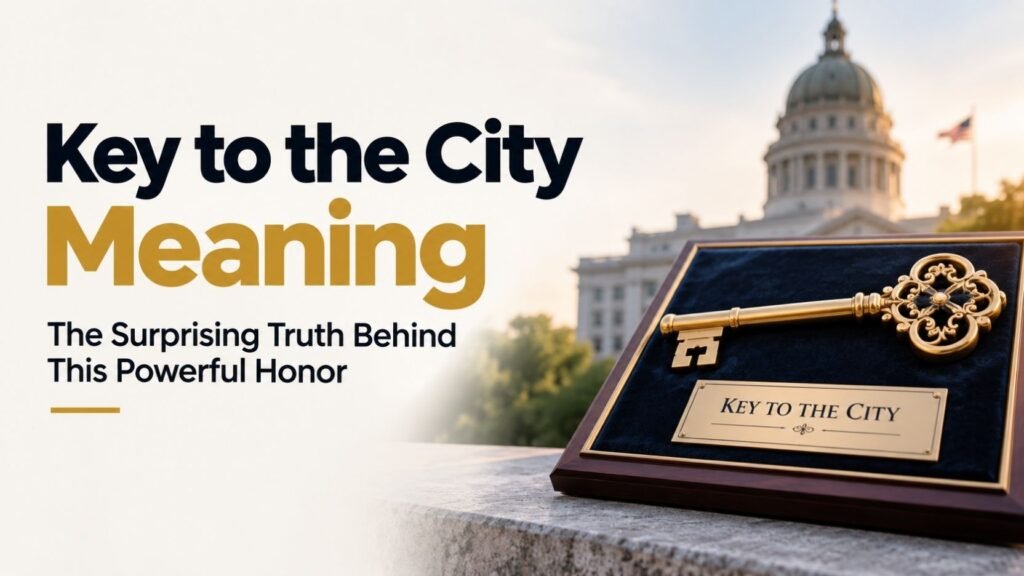
At its core, a key to the city is a symbolic gift, usually an oversized decorative key mounted on a plaque, that a municipality presents to a person it wishes to recognize. It is not a real key in the practical sense, and nobody expects the recipient to use it on an actual lock. Instead, the object stands in for something much larger: a public declaration that this individual belongs, is trusted, and has done something worth celebrating.
The key symbolizes the freedom of the recipient to enter and leave the city at will as a trusted friend of city residents, and in modern times, an ornamental key is presented to esteemed visitors, residents, or others the city wishes to honor. That single sentence captures why the tradition has survived for so long even after its original purpose disappeared. Cities no longer have walls or locked gates, yet the emotional weight of being handed a “key” still lands the same way it did centuries ago.
Different cities describe the honor in slightly different language, but the spirit rarely changes. In Springfield, Missouri, for example, officials describe it as a symbol reserved for people whose contribution rises to the highest level of civic achievement.
Quick Definition Box
| Term | Definition |
| Key to the City | A ceremonial, non functional award given by a mayor or council to honor a person’s achievement, service, or connection to the city |
| Freedom of the City | The formal, often older civic honor from which the key tradition descends, sometimes carrying limited historic privileges in the United Kingdom and Commonwealth countries |
| Recipient | Usually a distinguished visitor, local hero, celebrity, athlete, dignitary, or long serving public servant |
| Legal Power | None in the United States; purely symbolic and ceremonial |
The Origin of the Key to the City Tradition
To really understand the key to the city meaning, you have to go back to a time when cities were physical fortresses rather than open, sprawling metropolises. Walls surrounded most major towns in medieval Europe, and those walls existed for one reason: protection.
Medieval European cities were surrounded by walls, and their gates were guarded during the day and locked at night, so a literal key to those gates allowed a trusted visitor to come and go freely, bypassing the guards and curfews that applied to everyone else. Holding that key was not a small thing. It meant a person had earned enough trust from the city’s leaders that the normal rules of entry no longer applied to them.
Over time, as cities modernized and physical walls came down, the practical need for a working key vanished entirely. As walled cities disappeared and municipal governance modernized, the key lost every scrap of practical function, and what remained was the symbolism of trusting someone as a friend of the city, free to enter and leave at will. What could have been a forgotten custom instead evolved into something new: a public, ceremonial way of honoring people, even when there was no gate left to unlock.
How the Tradition Reached America
The custom did not stay confined to Europe. It crossed the Atlantic early in American colonial history, and New York City holds a particularly notable place in that story.
The first key to the city ever awarded in America was in New York City, all the way back in 1702, when then Mayor Philip French executed a Freedom of the City for Viscount Edward Cornbury, the governor of New York and New Jersey at the time. That single ceremony set a precedent that American cities have followed, in one form or another, for more than three centuries.
Historical Note Box:
In 1702, Philip French, the Mayor of New York, granted the Freedom of the City to Viscount Edward Cornbury, who had just arrived to serve as Governor of New York and New Jersey under Queen Anne. This is widely cited as the earliest documented instance of the honor in what would become the United States.
Freedom of the City: The Formal Root of the Tradition
Many people search for “key to the city meaning” without realizing there is a more formal, older cousin to the honor called Freedom of the City. Understanding this connection fills in a lot of the historical picture.
The award is also known as Freedom of the City, and in this way the ability to access everything is seen as the ultimate act of esteem.In the United Kingdom, this designation is still governed by actual law rather than pure custom. In the United Kingdom, the details are constrained by the Local Government Act 1972, which basically lets any city council or parish declare anyone an honorary freeman, with the only meaningful restriction being that if there is no executive mayor, it has to be done by a two thirds vote of the council.
That legal framework does not exist in the same way across most American cities. In the United States, the key to the city has always functioned as a purely symbolic gesture, decided at the discretion of local government rather than dictated by statute. This distinction matters if you are comparing how the honor works internationally versus how it works domestically.
What Does the Key to the City Actually Open?
This is one of the most common follow up questions people ask once they understand the basic Key to the City meaning, and the honest answer disappoints some readers. The short version: nothing.
The key is not a functioning key and will not get you into City Hall, and while the city welcomes your visit, entering a secure building at random without authorization will probably raise some questions, key or no key. The object itself is almost always decorative, mounted on a display plaque, and engraved with the recipient’s name for keepsake purposes rather than functional use.
That said, the honor is not entirely without perks in every case, even if those perks are informal rather than official. There is often a fancy dinner following the ceremony, and sometimes a small cash reward accompanies it, though in most cases the key itself is considered the reward. Do not expect free parking, discounted transit, or tax relief. It does not come with parking privileges, transit passes, or tax breaks of any kind.
Warning Box:
Do not assume a key to the city grants any real world access or legal privilege. It will not open doors, waive fees, or provide official identification. Treat it purely as a ceremonial honor and keepsake, never as a functional credential.
Who Decides Who Gets a Key to the City?
Unlike national awards with fixed committees and standardized criteria, the key to the city process is remarkably decentralized. Every municipality essentially writes its own rules, which explains why the honor can feel wildly different from one city to another.
There is no federal standard, no uniform state law, and no single rulebook governing who qualifies, so each city sets its own criteria and the process can be remarkably informal, with the mayor usually selecting the recipient, sometimes with input from a committee or city council, sometimes entirely at the mayor’s discretion.This flexibility is part of why the honor can go to a returning war hero one year and a touring pop star the next.
Some cities have published formal guidelines to bring a bit more structure to the process, even if final approval still rests with the mayor’s office. Memphis, Tennessee, offers a useful real world example of how this works in practice.
The City of Memphis defines criteria and processes for receiving a Proclamation, Letters, or the Key to the City, and requires all nominations and requests to include supporting documentation detailing achievements and impact, while final approval lies with the Office of the Mayor.Little Rock, Arkansas, takes a slightly different approach by reserving its highest ceremonial honor specifically for people from outside the city.
In Little Rock, the Key to the City is the highest ceremonial honor and is reserved for non residents, intended for distinguished visitors of national or international significance or for leaders in their field whose work has positively influenced the quality of life in the city.
Typical Qualifying Reasons
Cities generally hand out the honor for a fairly consistent set of reasons, even though the specific process varies. Here is a breakdown of the most common categories, based on documented examples across multiple American and Canadian cities.
| Category | Typical Recipient Example |
| Lifetime public service | A retiring congressman or long serving civil servant honored for decades of work |
| Heroic or life saving action | A pilot, first responder, or ordinary citizen who performed an extraordinary act |
| Cultural or artistic achievement | A musician, actor, or author whose work reflects the city’s identity |
| Athletic accomplishment | A championship team or standout athlete with local roots |
| Philanthropic contribution | A business leader or philanthropist who invested heavily in the community |
| Diplomatic or dignitary visit | A visiting head of state, ambassador, or foreign official |
Real Examples of People Who Received a Key to the City
Reading about the concept in the abstract only goes so far. Seeing how the honor has actually played out in recent years makes the key to the city meaning feel much more concrete.
New York City recently used the honor to recognize decades of public service rather than a single dramatic event. Mayor Eric Adams posthumously awarded a Key to the City of New York to former Congressman Charles B. Rangel, who passed away at age 94, honoring his lifetime of service to the city and the nation, including his tenure in the U.S. Army and his 46 year career in Congress.That example shows how the honor can serve as a form of public tribute even after someone has passed away.
Musicians and athletes are frequent recipients too, and two recent Canadian ceremonies illustrate this well. On July 26, the musician known as The Weeknd received the key to his hometown of Toronto, and on August 7, Hamilton celebrated NBA star Shai Gilgeous Alexander with a key to the city following his team’s championship run and his league MVP award.The Toronto mayor’s office framed the honor around his broader cultural and humanitarian impact rather than music alone. Toronto Mayor Olivia Chow said he had reshaped modern music while using his platform to support health and humanitarian causes at home and around the world.
Celebrities visiting on tour sometimes receive the honor too, tied to a specific performance or cultural moment rather than a lifetime of service. Recent thesaurus and dictionary usage data confirms just how frequently this happens in real news coverage. One recent example from Barron’s described a mayor awarding the symbolic key to an NBA team at City Hall following a championship celebration.
Real World Examples List
- A New York congressman honored posthumously for nearly five decades of public service
- A global music artist honored in his hometown for cultural and humanitarian impact
- A championship winning athlete honored for accomplishments on the court
- A touring performer honored during a stop on a major concert tour in Texas
- A World War era aviator honored for a heroic emergency landing that saved every passenger onboard
Key to the City Meaning in New York
New York City deserves its own section, since it is one of the most searched cities in relation to this topic and one of the oldest practitioners of the tradition in America. The city’s own communications describe the honor in fairly formal terms.
According to the city’s website, the Key to the City is a beloved symbol of civic recognition and gratitude reserved for individuals whose service to the public and the common good rises to the highest level of achievement. The city also frames the gesture in the same welcoming spirit that defined the medieval original. The city notes that it symbolically shows a wish that a guest feel free to come and go at will.
Given the city’s role in launching the American version of the tradition back in 1702, it makes sense that New York continues to treat the honor with a certain amount of ceremony and historical weight, whether the recipient is a local public servant, a touring musician, or a championship sports team.
Key to the City Meaning in Australia
Search interest also exists around how the honor works outside the United States, and Australia follows a broadly similar civic tradition, though naming conventions and ceremony styles can differ by city and state. Australian local councils generally use the honor the same way American cities do: as a discretionary, non legal recognition of achievement or service, typically decided by the mayor or council.
Because the American key to the city concept borrowed heavily from the older British Freedom of the City tradition, and Australia shares that same Commonwealth heritage, the underlying symbolism lines up closely across all three countries. The core idea, trust, welcome, and public gratitude expressed through a symbolic key, transcends any single national border.
Key to the City Meaning in Slang and Everyday Conversation
Not every use of the phrase relates to an actual civic ceremony. Over time, “key to the city” has picked up figurative meanings in everyday speech, online slang, and casual conversation, and this is one of the most searched angles of the topic.
In slang usage, “key to the city” refers to a hypothetical object that supposedly grants someone unrestricted access and control over a city, often used figuratively to describe someone with a lot of power or influence, whether a politician, a business tycoon, or a local celebrity. This figurative use shows up in headlines and everyday speech to describe someone who seems to have unusually smooth access, influence, or welcome somewhere.
You will also encounter the phrase used loosely as an exaggerated compliment between friends, meaning something close to “you can do no wrong here” or “you have earned complete trust.” This usage borrows the emotional core of the original honor, trust, and open access, without any actual ceremony attached. As with most internet slang, definitions can vary widely by community and context, and informal slang dictionaries sometimes include cruder or more explicit interpretations that have nothing to do with the civic tradition, so context always matters when you encounter the phrase online.
Quick Tip Box:
If you see “key to the city” used online outside of a news story about an actual ceremony, it is almost always figurative. Look at the surrounding context. A mayor’s office press release means the literal civic honor. A casual tweet or text message usually means the speaker is using it as a compliment or exaggeration about trust and access.
Key to the City Meaning in Relationships
People occasionally search for this phrase in a relationship context, usually after hearing it used as a romantic compliment. In that setting, telling someone they have the “key to the city” is a figurative way of saying they have earned your complete trust, openness, and welcome, much like the original civic gesture symbolized full access and friendship.
It is worth being thoughtful here rather than reading too much into a single phrase. Language borrowed from civic honors tends to get used loosely in casual and romantic conversation, and the intended meaning depends heavily on tone, context, and the relationship between the two people using it. If someone uses the phrase with you, the safest interpretation is simply that they are expressing deep trust or affection, not making any kind of formal or literal statement.
Key to the City in Pop Culture: The Spider Man Connection
Comic book and film fans frequently search for the phrase because of its recurring appearance in Spider Man stories, where the fictional key becomes a shorthand for public acceptance of the hero. This connection has become one of the more searched cultural angles of the whole topic.
In Spider Man 3, the city rewards Spider Man’s growing popularity by having the mayor’s office organize a ceremony where he receives the key to the city.That scene works precisely because audiences already understand the real world meaning: it signals that a community has fully embraced someone as one of its own. In more recent Marvel productions, the same beat reappears. In Spider Man Brand New Day, New York’s newest mayor is shown giving Spider Man the key to the city, a moment that also confirms a shift in the city’s political leadership within the story.
Screenwriters keep reaching for this image because it does a lot of narrative work in a very short scene. A key to the city ceremony instantly communicates public trust, communal gratitude, and a turning point in how a character is perceived, all without a single line of dialogue. That is a direct reflection of the honor’s real world symbolism carrying over into fiction.
How a Modern Key to the City Ceremony Works
Most ceremonies today follow a fairly predictable structure, even though the scale can range from a quiet City Hall meeting to a massive public event with press coverage. Understanding the typical flow helps make sense of why the honor still feels significant, even without any legal power attached.
- Nomination or request. Someone, often a city council member, community group, or the recipient’s representatives, submits a formal request or nomination, usually with supporting documentation about the person’s achievements.
- Review and approval. The mayor’s office reviews the request, sometimes alongside a committee or council vote, and decides whether the honor is appropriate.
- Ceremony planning. City staff coordinates timing, location, and any accompanying events, such as a reception, press conference, or public appearance.
- Public presentation. The mayor or another city official presents the ornamental key, usually mounted on a plaque and engraved with the recipient’s name, along with brief remarks explaining the honor.
- Media and public acknowledgment. Cities frequently issue a press release documenting the honor for public record and local news coverage.
Summary Box: What You Actually Receive
- A decorative, engraved key, almost always non functional
- A mounted plaque suitable for display
- Public recognition, often covered by local press
- A formal record in city archives or council minutes
- Occasionally, a small reception or dinner in the recipient’s honor
Key to the City Meaning: Comparing Modern Interpretations
Because the honor plays out differently depending on the city and the era, it helps to see the contrast laid out directly. The table below compares the medieval original with the modern American version most people encounter today.
| Aspect | Medieval Original | Modern American Honor |
| Function | Literal key that opened city gates | Purely decorative and symbolic |
| Legal Power | Granted real access and freedom from curfew | None whatsoever |
| Who Decided | City lords, councils, or ruling nobility | Mayor, sometimes with council input |
| Typical Recipient | Trusted allies, nobles, or military leaders | Public servants, celebrities, athletes, dignitaries |
| Ceremony Style | Formal courtly presentation | Ranges from small City Hall event to major public ceremony |
| Underlying Meaning | Trust and physical freedom of movement | Trust, gratitude, and public recognition |
Common Misconceptions About the Key to the City
Because the phrase sounds so literal, plenty of misunderstandings persist even among people who have watched a ceremony on the news. Clearing these up rounds out a complete understanding of the honor.
Misconception 1: It grants legal access to government buildings. It does not. The key does not unlock any doors and does not grant access to city buildings.Security protocols remain exactly the same for key recipients as for anyone else.
Misconception 2: Every city follows the same process. They do not. There is no federal standard, no uniform state law, and no single rulebook that governs who qualifies, since each city sets its own criteria.Some cities have detailed nomination processes; others operate almost entirely at the mayor’s personal discretion.
Misconception 3: Only celebrities receive the honor. While celebrity recipients generate the most headlines, the vast majority of keys quietly go to local public servants, community volunteers, veterans, and everyday people who made a meaningful local impact, often without any national media attention at all.
Misconception 4: The key is always made of real gold. Materials vary widely by city and budget. Keys are typically designed and manufactured using premium materials, commonly including gold or gold plated finishes, brass, or a pewter alloy with an antique gold finish.Not every key is solid precious metal, though most are crafted to look prestigious regardless of the underlying material.
Why the Tradition Still Matters Today
It would be easy to dismiss a ceremonial, non functional award as an empty gesture, especially once you know it does not open a single door. Yet the tradition keeps thriving, and it is worth asking why a symbolic object with zero legal power still generates headlines and genuine emotion from recipients.
The answer lies in what the key represents rather than what it does. A city choosing to publicly, formally, and permanently record its gratitude toward one person carries real emotional and cultural weight, regardless of whether the object itself functions. The honor remains a beloved symbol of civic recognition and gratitude reserved for individuals whose service to the public and the common good rises to the highest level of achievement.That is a powerful statement for a community to make about a single individual, and it is one reason the tradition has outlived the literal city walls that first inspired it.
Communities also use the ceremony as a teaching moment, reminding residents what values the city holds in highest regard. A key to the city given to a war hero sends a different message than one given to a touring pop star, and both messages matter to the people watching. The flexibility of the honor, decided locally without rigid national rules, allows each city to define what it wants to celebrate in its own voice.
See More: 399+ Names That Mean Timekeeper
Conculsion
The key to the city meaning boils down to trust, gratitude, and public recognition, wrapped in a tradition that stretches back to walled medieval towns and locked gates. Even though the modern version carries no legal weight and cannot open a single door, it still represents one of the most personal and public honors a community can bestow. Whether the recipient is a decorated congressman, a global music star, a heroic pilot, or a beloved local volunteer, the ceremony sends the same message it always has: this city trusts you, welcomes you, and wants the world to know it.
Frequently Asked Questions
What is the key to the city meaning in one sentence?
It is a ceremonial, non-functional honor a city gives to recognize someone’s achievement, service, or positive impact on the community.
Does a key to the city actually unlock anything?
No, it does not open doors, grant building access, or provide any legal privileges whatsoever.
Who decides who receives a key to the city?
Usually the mayor decides, sometimes with input from a city council or committee, and rules vary widely between cities.
Where did the key to the city tradition originate?
It began in medieval walled cities, where a literal key allowed trusted visitors to bypass locked gates and curfews.
When was the first key to the city awarded in America?
New York City awarded the honor in 1702, when Mayor Philip French granted it to Governor Edward Cornbury.
Can regular citizens receive a key to the city, or only celebrities?
Regular citizens, veterans, volunteers, and local public servants receive the honor far more often than celebrities do.
Is the key to the city the same thing as Freedom of the City?
They share the same symbolic roots, but Freedom of the City is the older, more formal designation, still legally defined in some countries like the United Kingdom.
Does the key to the city come with any money or benefits?
Typically no, though some ceremonies include a reception or dinner, and cash rewards are rare and never guaranteed.
Why do celebrities like Taylor Swift receive keys to the city?
Cities often award the honor to touring performers as a gesture of welcome and appreciation tied to a specific visit or performance.
What does it mean when Spider Man receives the key to the city in the movies?
It is a fictional shorthand signaling that the city has fully embraced the hero as a trusted, beloved member of the community.

Sana Saleem is the author of Meanz Vault, dedicated to researching and writing about word meanings, slang meanings, name meanings and language. With 4 years of experience, his aim is to provide clear, accurate, and easy-to-understand information that helps readers discover the meaning behind words, phrases, and names.