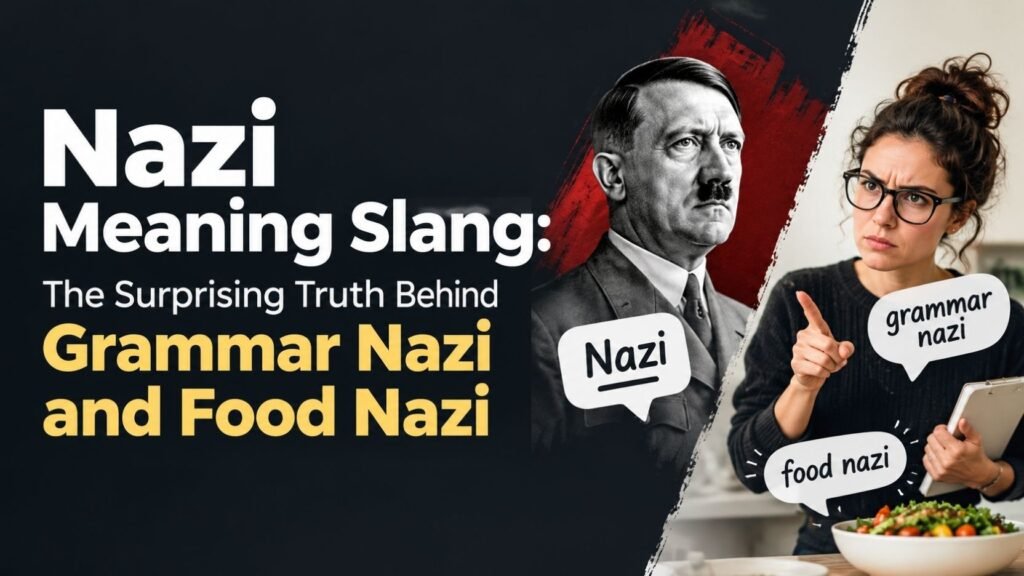
“Nazi” is a historical term for a member of Adolf Hitler’s National Socialist German Workers’ Party, and it is also used informally, in lowercase, as slang for someone who is bossy, controlling, or overly strict about a specific topic. That second, slang use is where terms like grammar nazi, food nazi, and soup nazi come from. Both uses matter, and they are not interchangeable. This guide explains the real meaning, the grammar, the history, and the modern slang so you understand exactly what the word means in any sentence you see it in.
The word carries serious historical weight, so how it is used really does matter. Capital “Nazi” refers to a real regime responsible for the Holocaust and the deaths of millions of people. Lowercase “nazi,” used as slang, is a casual exaggeration that many people find harmless and others find offensive. This article covers both, plus grammar, pronunciation, origin, and the related terms people search for most.
What Does Nazi Mean?
At its core, Nazi has one historical meaning and one extended, informal meaning.
Meaning 1: The historical and political term.
A Nazi was a member of the Nationalsozialistische Deutsche Arbeiterpartei, or National Socialist German Workers’ Party, the far right political party led by Adolf Hitler that controlled Germany from 1933 to 1945. Merriam-Webster defines a Nazi as a member of this party, and more broadly as anyone who espouses the beliefs and policies of the German Nazis, meaning fascism.
In this sense, the word is always capitalized and refers to a real historical movement responsible for World War Two and the Holocaust, in which six million Jews and millions of others were murdered.
Meaning 2: The informal, lowercase slang term.
Merriam-Webster also lists a second, informal sense: someone who is likened to a German Nazi, meaning a harshly domineering, dictatorial, or intolerant person. This is the sense behind phrases like grammar nazi. In this usage, the word is stripped of its political and historical content and just means “someone who is extremely strict or controlling about one specific thing.”
The difference between these two meanings is the difference between a historical fact and a figure of speech, and mixing them up is where most confusion starts.
Read More: Cerote Guatemala Meaning
Nazi Grammar: Part of Speech, Capitalization And Word Forms
| Feature | Detail |
| Part of speech | Noun (a Nazi, the Nazis) and adjective (Nazi Germany, Nazi propaganda) |
| Singular | Nazi |
| Plural | Nazis |
| Capitalization, historical sense | Always capitalized, as a proper noun referring to the party and its members |
| Capitalization, slang sense | Usually lowercase, as in grammar nazi or food nazi, though style guides vary |
| Related noun | Nazism (the ideology) |
| Related verb forms | Nazify, nazification |
A quick grammar note: when the word refers to the historical political party or its members, capitalize it, the same way you would capitalize Republican or Democrat. When it is used as loose slang for a strict or bossy person, many publications lowercase it, though usage is inconsistent and some style guides still recommend capitalizing it out of respect for its origin.
Common Mistakes
❌ Incorrect: “natzi” or “nazzi”
✅ Correct: “Nazi”
The word is often misspelled as natzi or nazi meaning gets searched alongside these variants, but there is only one correct English spelling: Nazi, from the German abbreviation of Nationalsozialist.
❌ Incorrect: Using “Nazi” casually to describe someone you simply disagree with.
✅ Better: Reserve the term, even in its slang form, for genuinely controlling or rigid behavior, and know that many people consider the joking use disrespectful given the word’s history.
Origin And Etymology Of Nazi
Nazi is a shortened form of the German word Nationalsozialist, meaning National Socialist, taken from the full party name Nationalsozialistische Deutsche Arbeiterpartei, or NSDAP. The word entered English around 1930, shortly before Hitler’s party rose to national power.
There is a second layer to the word’s history that many readers find surprising. According to etymological research, “Nazi” was already a mocking nickname in southern Germany before it was linked to Hitler’s party. It echoed “Nazi” or “Naczi,” a folksy, insulting nickname for the German name Ignatz, used to describe a foolish or clumsy person. Because Ignatz was a common name in Catholic Bavaria and Austria, opponents of the National Socialists seized on the coincidence: the first syllables of Nationalsozialist happened to sound like this existing insult, and the nickname stuck as a way to mock the party.
This is an important detail for anyone researching Nazi meaning slang. The word Nazi began, in part, as an insult invented by the party’s opponents, not a name the party chose for itself.
Why Hitler And The Nazi Party Disliked The Term
Party members generally called themselves Nationalsozialisten, or National Socialists, and largely avoided the word Nazi. Adolf Hitler reportedly never used the term in his own speeches, and senior officials such as Hermann Göring avoided it as well.
Some Nazi propagandists, including Joseph Goebbels, tried to reclaim the insult by using it themselves, but the party never fully embraced the label. It was German exiles who fled the country in the 1930s and 1940s who popularized the terms Nazi Germany and Nazi regime internationally, and the word eventually returned to Germany after the war as the standard historical term.
Nazi Meaning In German
In German, Nazi is a colloquial shortening of Nationalsozialist, built from Nation (nation) and Sozialist (socialist), the same way English speakers might shorten a long compound word. It was pronounced roughly like the first syllables of “national,” blended with the popular German abbreviation “Sozi” for socialist.
Today, in modern German as in English, Nazi refers to a member or supporter of the historical National Socialist movement, and it carries the same serious historical weight in Germany, arguably even more so, since Germany has strict laws against displaying Nazi symbols and promoting Nazi ideology.
Nazi as Everyday Slang: The Grammar Nazi, Food Nazi And Similar Terms
Since the mid to late twentieth century, English speakers have used lowercase “nazi” as an informal suffix attached to a topic, to describe someone who is unusually strict, controlling, or humorless about that one specific thing. This is the pattern behind almost every “blank nazi” phrase people search for.
| Term | What It Means | Example Sentence |
| Grammar nazi | Someone who constantly corrects other people’s spelling, grammar, or punctuation, often in casual settings where it is not needed | “I fixed your typo.” “Okay, grammar nazi, we get it.” |
| Food nazi | Someone who is extremely strict or judgmental about what other people eat | “My roommate is a total food nazi about sugar.” |
| Soup nazi | A reference to a strict, no-exceptions vendor, popularized by a 1995 episode of the sitcom Seinfeld about a soup seller with rigid ordering rules | “Order fast, he’s a real soup nazi about the line.” |
| Time nazi | Someone who is unusually rigid about punctuality or schedules | “She’s a time nazi, so don’t be even five minutes late.” |
| Feminazi | A dismissive, politically loaded slang term for a feminist viewed as extreme, popularized in American talk radio in the 1990s | Rarely used neutrally; considered offensive by many. |
Each of these follows the same pattern: take an ordinary topic, such as grammar, food, or time, and attach the informal sense of “nazi” to signal extreme, rigid, and often unwelcome strictness.
Grammar Nazi Meaning: In Depth
A grammar nazi is a person who habitually corrects other people’s grammar, spelling, or punctuation, often in casual conversation where the correction is unnecessary or unwelcome. Wikipedia traces the phrase to online discussion forums in the 1990s, with an earlier related use of “nazi” as a label for pedantic rule enforcers appearing in a 1982 magazine article about strict rule followers. Dictionary.com notes that the phrase was recorded on an internet forum as early as 1990, a few years before the Seinfeld “Soup Nazi” episode helped popularize the broader “blank nazi” pattern in American pop culture.
It is worth noting that critics, including linguists, point out two problems with the term. First, using “nazi” this casually can feel like it trivializes a genocide by comparing it to something as minor as a misplaced comma. Second, grammar nazis are often technically wrong themselves, since many of the rules they enforce, like never ending a sentence with a preposition, are personal preferences rather than actual grammar rules, and they can overlook that formal Standard English is only one valid register of the language, not the only correct way to speak.
Read More: IMYY Meaning In Text
Food Nazi Meaning
A food nazi is someone who imposes strict, judgmental rules about eating, whether about calories, ingredients, portion sizes, or what other people choose to order. The term is used both jokingly, about a strict but well-meaning friend, and critically, about someone whose comments on other people’s food choices feel controlling or shaming.
Neo-Nazi Meaning
A neo-Nazi is a person or group that follows the ideology of Nazism after the fall of Nazi Germany in 1945. The prefix “neo” means “new,” so neo-Nazi literally means “new Nazi.” Neo-Nazi movements adopt symbols, language, and ideas from the historical Nazi Party, including racial supremacy and antisemitism, and apply them in a modern context, often outside Germany. Neo-Nazism is treated as a distinct but related topic to historical Nazism by researchers, since it describes a post-war revival of the ideology rather than the original regime itself.
SS, SA And Aryan: Related Nazi-Era Terms
Several other keywords tied to this topic point to specific organizations and concepts inside the Nazi regime rather than to the word “Nazi” itself. Understanding them in context helps make sense of related searches.
| Term | Meaning |
| SS (Schutzstaffel) | Literally “protective echelon.” Originally Hitler’s personal bodyguard unit, the SS grew into a powerful paramilitary and police organization responsible for running concentration camps and carrying out much of the Holocaust. |
| SA (Sturmabteilung) | Literally “storm detachment,” also known as the Brownshirts. This was the Nazi Party’s original paramilitary wing, active before the SS grew into the dominant force. |
| Aryan | A pseudo-scientific racial term the Nazis used for people they claimed were of “pure” Northern European descent. Nazi ideology falsely and dangerously treated this group as biologically superior, and it was central to the regime’s discrimination and genocide. |
| 1919 | The year the German Workers’ Party, the forerunner of the Nazi Party, was founded in Munich. Hitler joined that same year, and the party was renamed the National Socialist German Workers’ Party in 1920. |
Blood And Soil: What the Slogan Means
“Blood and soil,” translated from the German “Blut und Boden,” was a Nazi-era slogan that linked German ethnic identity (“blood”) to the German homeland and rural land (“soil”). According to the United States Holocaust Memorial Museum, the phrase evoked the idea of a supposedly pure “Aryan” race tied to territory the regime wanted to control, and it was used to justify land seizures and to glorify German farmers as the “authentic” backbone of the nation.
The Anti-Defamation League notes that the slogan predates the Nazi Party but was popularized under the regime and has since been revived by modern white supremacist and neo-Nazi movements, most visibly when it was chanted at the 2017 Charlottesville rally.
The Numeric Code 88 And Related Symbols
Search interest in “88 nazi meaning” refers to a specific coded number used by some white supremacist and neo-Nazi individuals and groups. According to the Anti-Defamation League’s hate symbols database, 88 is a numeric substitution code standing for “Heil Hitler,” because H is the eighth letter of the alphabet, making 88 shorthand for “HH.”
It appears in tattoos, usernames, and merchandise, and it is sometimes combined with the number 14, a reference to a separate white supremacist slogan, to form “1488.” This is educational, historical context: these codes are documented by organizations like the ADL specifically so the public, educators, and law enforcement can recognize and understand them, not as an endorsement of their meaning.
Crypto-Nazi Meaning
A crypto-Nazi is someone who privately holds Nazi or neo-Nazi sympathies while publicly hiding or downplaying them. The prefix “crypto,” from the Greek word for “hidden,” is used the same way in terms like “crypto-fascist,” to describe a person or view that is disguised rather than openly declared.
Pronunciation
Nazi is pronounced NAHT-see in careful, dictionary-standard American English, close to the German original, and it is also commonly heard as NAT-see in everyday American speech. Merriam-Webster lists both pronunciations. The stress always falls on the first syllable.
Nazi Meaning For Kids
For a younger reader or a simple explanation, Nazi refers to a political group that ruled Germany a long time ago, from 1933 to 1945, led by a man named Adolf Hitler. This group started a war that involved much of the world, called World War Two, and it treated Jewish people and many other groups extremely unfairly and cruelly because of who they were.
Today, calling someone “a nazi” as a joke, like a “grammar nazi,” is a separate, casual way of saying someone is being extremely strict about a small thing, and it has nothing to do with the historical group, though many adults choose not to use the joke at all because of how serious the real history is.
Is “Nazi” Connected to Similar-Sounding Words in Other Languages?
Because the word Nazi sounds similar to unrelated words in other languages, it is worth clarifying a few common points of confusion.
- In Arabic and Urdu naming traditions, “Nazish” or “Nazis” is an unrelated given name meaning something close to “pride” or “delicate elegance.” It has no connection to the German political term.
- In Persian and Georgian, “nazi” is also an unrelated given name meaning “gentle” or “delicate.”
- Claims that circulate online suggesting “Nazi” is a Hebrew word for “prince” are a popular myth rather than an accepted etymology among linguists; reputable etymology sources trace the word to the German Nationalsozialist, not to Hebrew.
- The similar-looking word “Ashkenazi,” used for Jews of Central and Eastern European descent, comes from the unrelated Hebrew word “Ashkenaz,” historically associated with Germany. Despite the visual similarity, it is not the source of the word Nazi.
These are genuinely separate words that happen to share some letters, not alternate meanings of the same term.
Read More: What Does HYY Mean In Text?
Synonyms and Related Words
| Word | Meaning | How It Differs From Nazi |
| Fascist | A supporter of fascism, an authoritarian, ultranationalist political ideology | Broader category; Nazism is one specific, extreme form of fascism tied to German history and racial ideology |
| Pedant | Someone excessively concerned with minor rules or details | Neutral term with no historical baggage, closest to the intended meaning of “grammar nazi” without the loaded comparison |
| Authoritarian | Someone who favors strict obedience to authority | Broader, more neutral political term |
| Extremist | Someone holding radical, often violent political views | Applies to many ideologies, not only Nazism |
Frequently Asked Questions
What does “nazi” mean in slang?
As slang, “nazi” describes someone who is extremely strict, rigid, or controlling about one particular topic, as in “grammar nazi” or “food nazi.” It is a lowercase, informal use, separate from the historical political term.
Is it offensive to use “nazi” as a joke, like in “grammar nazi”?
Many people use it casually without intending offense, but others consider it disrespectful because it compares minor annoyances to a genocide. There is no single agreed-upon answer, and reasonable people disagree about whether the joking use is acceptable.
Is “Nazi” a noun or an adjective?
It works as both. As a noun, it means a member of the party or, informally, a controlling person. As an adjective, it describes something related to the party or regime, as in “Nazi Germany” or “Nazi propaganda.”
How do you pronounce Nazi?
It is pronounced NAHT-see, close to the German original, and is also commonly heard as NAT-see in casual American English.
What is the difference between Nazi and neo-Nazi?
“Nazi” refers to the historical party and regime that existed in Germany from 1933 to 1945. “Neo-Nazi” refers to modern individuals or groups that revive and follow that ideology after the regime’s fall.
Where does the word Nazi come from?
It is a shortened German form of Nationalsozialist, National Socialist, and it also echoes an older German nickname used to mock people as foolish, which helped the term catch on as an insult before it became the standard historical label.
What does SS stand for in relation to the Nazis?
SS stands for Schutzstaffel, meaning “protective echelon,” a Nazi paramilitary and police organization that carried out much of the Holocaust.
Conclusion
“Nazi” has one historical meaning, a member of the National Socialist German Workers’ Party that ruled Germany from 1933 to 1945 and carried out the Holocaust, and one informal, lowercase slang meaning, someone extremely strict or controlling about a specific topic, as seen in terms like grammar nazi and food nazi. The word’s origin traces back to a shortened form of Nationalsozialist, layered with an older German insult that made the nickname stick even before the party rose to power, and understanding that history explains why the word carries so much weight even in its lighter, joking use today.
Whether you came here to check a spelling, understand a slang term a friend used, or research the history behind related words like SS, Aryan, or blood and soil, the key takeaway is the same: context decides the meaning. Capitalized and historical, it names one of the most destructive regimes in modern history. Lowercase and casual, it is a shorthand, however imperfect, for stubborn strictness, and knowing the difference helps you use and understand the word accurately.

Sana Saleem is the author of Meanz Vault, dedicated to researching and writing about word meanings, slang meanings, name meanings and language. With 4 years of experience, his aim is to provide clear, accurate, and easy-to-understand information that helps readers discover the meaning behind words, phrases, and names.