
Quick Answer
WTV is short for “whatever.” People type it in texts, group chats, and comments when they don’t have a strong opinion, don’t want to keep arguing, or genuinely don’t care which option gets picked. The tricky part isn’t the definition; it’s the tone, because the same three letters can sound relaxed and easygoing in one message and cold or annoyed in the next.
If you’ve ever gotten a one word “wtv” back from someone and wondered whether they were mad at you, you’re not alone. This guide breaks down what WTV means in every common context: texting, Instagram, Snapchat, TikTok, gaming chats, and casual conversation so you can read it correctly and use it without sending the wrong signal.
See More: 350+ Names That Mean Wild
What Does WTV Stand For?
WTV stands for “whatever.” It’s a texting abbreviation, not a new word — people simply dropped the vowels to type it faster. That’s the same pattern behind other common shortcuts like “btw” for “by the way” or “idk” for “I don’t know.”
Quick Facts
| Term | Full Form | Common Meaning |
| WTV | Whatever | Indifference, mild agreement, or dismissal |
| WTVR | Whatever | Same as WTV, slightly more emphatic |
| WTVA | Whatever | Same meaning, regional or personal shorthand |
| Down for WTV | Down for whatever | Open to any plan, no preference |
There’s no single official inventor of the abbreviation. It emerged the same way most SMS-era slang did: character limits and the habit of typing fast on small keyboards pushed people to compress common phrases. “Whatever” was already one of the most frequently used words in casual English, so shortening it to three letters was almost inevitable once texting took off.
WTV Meaning In Chat: The Core Definition
In a chat context, WTV almost always means one of these three things: the person has no preference, the person is agreeing without much enthusiasm, or the person wants to end the topic. Which one applies depends entirely on what came before it in the conversation.
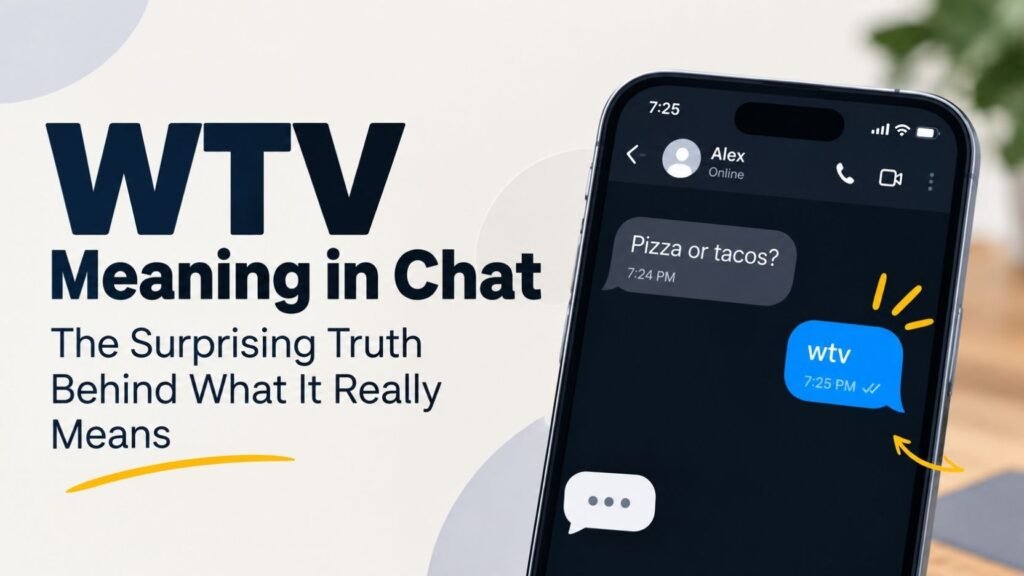
Here’s a simple way to think about it. If WTV shows up as an answer to a question with no emotional weight like “pizza or tacos?” it usually just means “I really don’t mind, you choose.” If it shows up after a disagreement, a delayed reply, or a sensitive topic, it’s more likely being used to shut the conversation down.
Note: Text strips out tone of voice and facial expression, so the same word can be read two completely different ways by two different people. When you’re unsure how a “wtv” was meant, the safest move is to ask, rather than assume the worst.
How WTV Changes Meaning Depending on Tone
Because there’s no vocal inflection in a text message, WTV relies heavily on context clues: punctuation, capitalization, what was said right before it, and the general relationship between the two people talking.
When WTV Sounds Relaxed and Friendly
- Used to answer low stakes questions (“movie or dinner first? wtv, up to you”)
- Paired with a smiley, a laughing emoji, or lowercase casual phrasing
- Comes from someone who is generally easygoing in how they text
- Sent quickly, without a long pause beforehand
When WTV Sounds Dismissive or Annoyed
- Sent as a one word reply with no punctuation after a disagreement
- Follows a message where the other person seemed upset or was explaining themselves
- Comes after a noticeable delay, especially following an unanswered question
- Paired with a period, which in text culture often reads as more final or curt than no punctuation at all
Example
Person A: “Sorry I didn’t text back, work was crazy.” Person B: “wtv.”
In that exchange, “wtv.” isn’t about indifference toward a decision it reads as someone signaling they’re annoyed and don’t want to keep discussing it. Compare that with:
Person A: “You want to grab coffee or just hang at my place?” Person B: “wtv sounds good either way!”
Same word, completely different feeling, because the surrounding context and punctuation do all the work.
WTV Meaning on Instagram, Snapchat, and TikTok
The core meaning of WTV doesn’t change from platform to platform it’s still short for “whatever” everywhere it appears. What changes is how often it shows up and what it tends to be responding to.
| Platform | Typical Use |
| Comments and DMs, often replying to a caption, story, or casual question | |
| Snapchat | Fast back and forth chats where messages disappear quickly, so short slang is preferred |
| TikTok | Comment sections and duets, sometimes used sarcastically in reaction to a video |
| Group chats and gaming chats | Ending a mid conversation debate quickly so the group can move on |
On Snapchat specifically, the disappearing nature of messages pushes people toward shorter slang in general, so WTV shows up frequently simply because it’s fast to type. On TikTok, it’s also common in a more sarcastic register, where a commenter uses “wtv” to mock or brush off a video’s point rather than express genuine indifference.
Quick Tip: If you see “wtv” under a TikTok video rather than in a private chat, check the tone of the rest of the comment. Public comment sections use WTV sarcastically far more often than a private text conversation would.
WTV From a Guy vs. WTV From a Girl: Does Gender Change the Meaning?
The abbreviation itself doesn’t have a different dictionary meaning depending on who sends it; “whatever” means the same thing regardless of gender. What people are usually really asking when they search “wtv meaning in chat from a girl” or “from a guy” is how to interpret it inside a specific relationship dynamic, especially in the early stages of talking to someone romantically.
In that context, a one word “wtv” reply from anyone after a message that took some effort to write (an apology, an explanation, an invitation) is generally a sign of low interest or mild frustration, not genuine neutrality. On the other hand, a “wtv” that answers a genuinely low stakes question, like picking a restaurant, usually is exactly what it looks like: no strong preference either way.
Warning: Don’t over-analyze a single “wtv” in isolation. Look at the pattern across several messages tone, response time, and effort rather than reading an entire relationship into three letters.
Common Variations of WTV
Slang rarely stays static, and WTV has picked up a few close relatives that mean nearly the same thing with small differences in emphasis.
- WTVR “Whatever,” used the same way as WTV, sometimes felt as slightly more dismissive because of the extra letter.
- WTVA Functions identically to WTV in most casual conversations; largely a stylistic variant.
- Down for WTV Means someone is open to any plan and has no fixed idea in mind. If a friend texts “I’m down for wtv tonight,” they’re telling you they’ll go along with whatever you decide.
- WTV atp Combines “whatever” with “at this point,” used to say someone has reached a point of not caring anymore after a long back and forth.
WTV in Gaming and Group Chats
Gamers use WTV constantly in voice chat and text chat during matches, usually to move past a disagreement quickly so the game can keep going. If two teammates are arguing over strategy mid match, one might type “wtv let’s just go” to signal that continuing the debate isn’t worth the lost time when there’s an active round happening.
In this setting, WTV is less about emotion and more about efficiency. Nobody wants to lose a match because two players were busy typing out a full argument, so “wtv” functions as a quick way to table the disagreement and refocus on the game.
Is WTV Rude?
WTV can come across as rude, but it isn’t rude by default. Whether it lands as dismissive depends on the situation it’s used in, the punctuation attached to it, and the relationship between the people texting.
Table: When WTV Is Usually Fine vs. When It Can Sting
| Situation | How WTV Usually Reads |
| Choosing between two casual options | Neutral, helpful — shows flexibility |
| Reply to someone’s apology or explanation | Often reads as dismissive or annoyed |
| Reply during a serious or emotional conversation | Frequently comes across as cold or shutting the person out |
| Reply to a joke or lighthearted message | Usually harmless, sometimes even playful |
| Professional or formal messages | Almost always inappropriate |
A general rule worth keeping in mind: the more emotional weight a message carries, the more a one word “wtv” reply is likely to land badly, even if that wasn’t the sender’s intention.
When Not to Use WTV
WTV belongs firmly in casual, informal communication. It’s not appropriate in professional emails, workplace messaging, messages to teachers or professors, or any conversation where you want to be taken seriously.
- Avoid it in job related messages, even casual workplace chat apps like Slack, unless your workplace culture is extremely informal.
- Avoid it as a reply to someone who is visibly upset or trying to have a real conversation with you.
- Avoid it in first conversations with someone new, since they don’t yet know your texting style and may read it as disinterest.
- Avoid pairing it with a period if you want to sound relaxed rather than curt; punctuation changes the temperature of a short reply more than people expect.
See More: 350+ Names That Mean Silent
Conculsion
WTV means “whatever,” and in most chats that’s exactly as simple as it sounds — a fast way to say someone doesn’t have a strong preference or wants to keep things moving. The word only gets complicated when it shows up after something emotional, where punctuation, timing, and context turn three letters into a much bigger signal. Read the conversation around it, not just the word itself, and you’ll rarely misjudge what someone actually meant.
Frequently Asked Questions
What does WTV mean in a text message?
WTV means “whatever.” It signals that the sender has no strong preference, is agreeing without much enthusiasm, or wants to end the topic.
Is WTV the same as WTVR?
Yes. WTVR is just a slightly longer version of WTV, and both mean “whatever.”
What does “down for wtv” mean?
It means someone is open to doing anything and doesn’t have a specific plan in mind.
Is WTV rude to text someone?
Not inherently. It depends on the context — a casual question makes it harmless, while a serious or emotional conversation can make it feel dismissive.
What does WTV mean on Snapchat?
The same thing it means everywhere else: “whatever.” It’s especially common on Snapchat because messages disappear quickly, which favors short slang.
What does WTV mean on TikTok?
Usually “whatever,” though in comment sections it’s sometimes used sarcastically to brush off a video’s message.
Does WTV mean something different from a girl versus a guy?
No, the word itself doesn’t change meaning by gender. What matters is the context and relationship it’s used in, not who sent it.
Can WTV mean something other than “whatever”?
In everyday texting and chat, “whatever” is by far the dominant meaning. In unrelated, niche contexts outside of casual chat, the same letters can stand for other things, but those uses are uncommon in normal conversation.
Is it okay to use WTV with someone I just started talking to?
It’s risky. Since they don’t know your texting habits yet, a new match or acquaintance is more likely to read a bare “wtv” as disinterest.
How should I reply if someone sends me just “wtv”?
Consider the context first. If it followed a low stakes question, respond normally. If it followed something emotional, it may be worth gently checking in rather than assuming the worst.

Sana Saleem is the author of Meanz Vault, dedicated to researching and writing about word meanings, slang meanings, name meanings and language. With 4 years of experience, his aim is to provide clear, accurate, and easy-to-understand information that helps readers discover the meaning behind words, phrases, and names.