
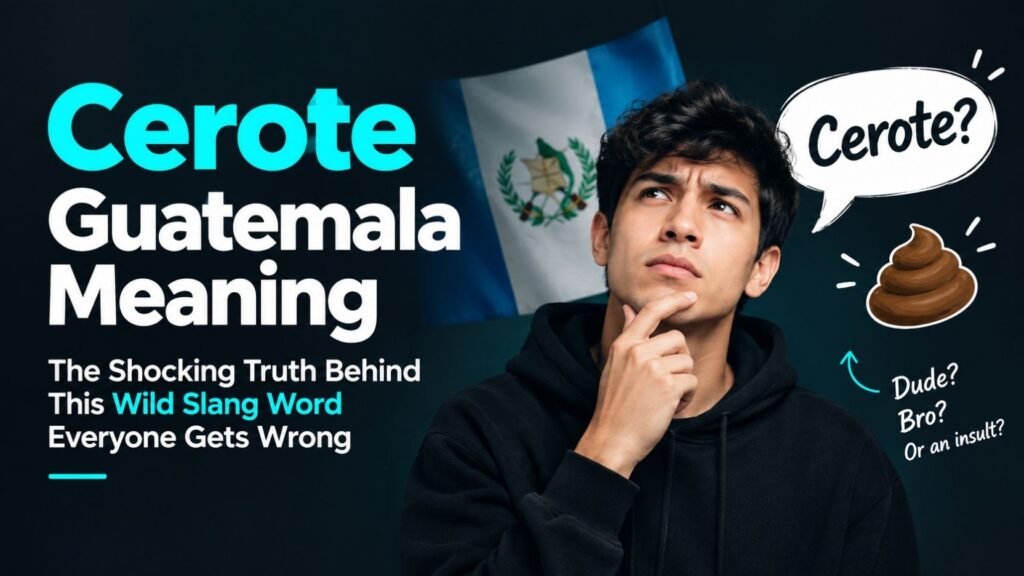
Cerote (say it: seh ROH teh) is a Guatemalan Spanish slang word that literally means a piece of solid excrement, but in everyday conversation it is used very differently. Among close friends, cerote works like “dude,” “bro,” or “mate.” Said with a different tone, aimed at a stranger, it becomes a genuine insult.
The Real Academia Española’s own Diccionario de americanismos confirms the literal, vulgar meaning across Guatemala, Honduras, El Salvador, Nicaragua, Mexico, Costa Rica, and Argentina, while the friendly “dude” usage is a Guatemalan cultural development layered on top of that older meaning.
That contradiction, an ugly literal meaning paired with an affectionate everyday use, is exactly what makes cerote confusing for anyone learning Guatemalan Spanish. This guide breaks down every layer of the word so you actually understand it instead of just memorizing a translation.
What Does Cerote Mean In Guatemala?
In Guatemala, cerote has two lives. The first is its literal, dictionary meaning: a piece of solid excrement, roughly equivalent to “turd” in English. The second is its street meaning: a casual, often affectionate way of addressing a close friend, similar to how some English speakers use “dude” or “bro” with people they know well.
Here is the part that trips up most learners. The word never fully sheds its crude origin, so its friendliness depends entirely on who says it, how they say it, and who they are talking to. A Guatemalan greeting a lifelong friend with “¿Qué onda, cerote?” is being warm. The exact same word, spat out at a stranger during an argument, is a straight insult.
Quick Definition Box Word: Cerote
Pronunciation: seh ROH teh (IPA: /seˈɾote/)
Part of speech: Masculine noun
Literal meaning: A piece of solid human or animal excrement
Common Guatemalan slang meaning: “Dude,” “bro,” “mate,” or “buddy” among close friends
Alternate slang meaning: An insult similar to “jerk,” “loser,” or a much stronger curse word, depending on tone Where it is used: Primarily Guatemala, also heard in El Salvador, Honduras, and Nicaragua
Formality level: Highly informal; never used in professional or formal settings
Read More: IMYYY Meaning Revealed
Cerote Guatemala Meaning In English: The Literal Translation
If you look this word up in a formal Spanish dictionary, the answer is blunt. According to the Diccionario de la lengua española, published by the Real Academia Española, cerote historically referred to a mixture of pitch and wax, or pitch and oil, that shoemakers used to wax the thread they sewed shoes with. That is the oldest, most technical meaning, and it is still the first definition listed in Spain’s national dictionary.
The Diccionario de americanismos, compiled by the Association of Academies of the Spanish Language, lists a very different regional meaning. It defines cerote as a solid, cylindrical piece of excrement, marking the word as vulgar and noting its use across Mexico, Guatemala, Honduras, El Salvador, Nicaragua, Costa Rica, and Argentina. In plain English, this is the meaning most Central Americans think of first when they hear the word, and it is genuinely crude, comparable to “turd” or “piece of crap.”
So when someone searches “cerote Guatemala meaning in English,” the honest, dictionary-backed answer has two parts. Literally, it translates to a piece of excrement. Colloquially, in Guatemalan street Spanish, it has been repurposed into a term that can mean “dude” among friends or “jerk” as an insult, and the correct translation always depends on context.
Cerote Guatemala Meaning In Spanish
For Spanish speakers researching this term directly, the same duality applies. In standard, formal Spanish, cerote (excremento) is simply crude slang for feces, nothing more. In Guatemalan Spanish specifically, cerote has picked up a second identity as chapín slang, the informal name Guatemalans use for their own local speech patterns.
Within that slang system, cerote functions as a flexible address term that can swing from affectionate to hostile within the same conversation, depending entirely on tone and relationship.
Where Does the Word Cerote Come From? Origin And Etymology
The etymology here is more interesting than most slang dictionaries let on, and it is worth explaining properly because it clears up a lot of confusion.
Cerote comes from the Spanish word cera, meaning “wax.” According to the RAE’s historical dictionary project, the Tesoro de los diccionarios históricos, the word entered Spanish through the Latin term ceratum. Its original, oldest sense had nothing to do with insults or excrement at all. It described the sticky mixture of pitch, wax, or oil that cobblers rubbed onto sewing thread to strengthen it before stitching leather.
That original craftsman’s term is documented as far back as the 1729 Diccionario de Autoridades, the first dictionary ever produced by the Real Academia Española, which defined cerote as a paste made by shoemakers from pitch and oil to wax their thread. Regional Spanish sources also note that the ball of blackish, sticky wax cobblers produced bore a visual resemblance to a piece of solid excrement, and that resemblance is widely believed to be how the vulgar secondary meaning developed over time.
Once that shift happened in colonial-era Spanish, different Spanish-speaking regions carried the word forward in different directions. Some areas of Spain, like the town of Peraleda in Extremadura, still use variations of the word for animal droppings. Several Latin American countries adopted “excrement” as the dominant everyday meaning.
Guatemala went one step further and turned that crude noun into a term of address between friends, a linguistic move that linguists sometimes describe as reclaiming or softening an originally offensive word through repeated casual use, similar to how some slang terms in other languages evolve from insults into markers of closeness.
Note Box: Why the Friendly Meaning Developed Language researchers who study Guatemalan Spanish, including a documented Central American vocabulary project at the University of Notre Dame, describe cerote as primarily a younger-generation term used as a name for close friends. This pattern, where a rough or taboo word gets repurposed as an in-group nickname, is common across many languages and is not unique to Guatemala.
How Guatemalans Actually Use Cerote Today
Understanding the dictionary definition only gets you halfway there. What matters more for real conversations is how the word functions socially. Guatemalan Spanish speakers use cerote in at least three distinct ways, and recognizing which one is happening requires paying attention to tone, relationship, and context rather than the word itself.
1. As a Friendly Nickname Between Close Friends
This is the usage most travel blogs and language guides highlight first, and it is genuinely common among young and middle-aged Guatemalan men in particular. Used this way, cerote functions almost exactly like “dude,” “bro,” or “man” in casual American English. A typical exchange might sound like “¿Qué onda, cerote?” which translates loosely to “What’s up, dude?”
This friendly usage tends to appear specifically among people who already have an established, comfortable relationship. It signals familiarity rather than distance, which is part of why it can be so jarring to outsiders who only know the literal, crude meaning of the word.
2. As an Insult or Put-Down
The older, harsher usage never went away, and it remains just as common as the friendly version. Said with irritation, anger, or contempt, cerote becomes equivalent to calling someone a “jerk,” “loser,” “scumbag,” or something considerably more vulgar depending on the surrounding words. Guatemalan slang resources consistently describe this as the traditional use of the term, predating its adoption as a friendly nickname.
Context makes the difference obvious to native speakers almost instantly. Calling a stranger who cut you off in traffic a cerote is an insult. Calling your childhood best friend a cerote while laughing is not.
3. As an Adjective Describing a Bad Situation
Less commonly, Guatemalans also use cerote as a descriptor for something difficult, unpleasant, or going badly, closer to saying a situation “sucks” or is “rough.” This usage extends the negative core meaning of the word into circumstances rather than people, and it shows up less often in casual conversation than the two uses above.
| Usage | English Equivalent | Typical Context | Tone |
| Friendly address | “Dude,” “bro,” “mate” | Between established close friends | Warm, casual |
| Insult toward a person | “Jerk,” “loser,” “scumbag” | Toward a stranger or someone you dislike | Hostile, angry |
| Describing a situation | “Rough,” “messed up” | Talking about a bad or difficult event | Frustrated, exasperated |
| Literal meaning | “Turd,” “piece of crap” | Rarely used literally in conversation; mostly historical or dictionary sense | Vulgar, blunt |
Warning Box: Do not use cerote with someone you have just met, with strangers, in professional settings, or with older Guatemalans you do not know well. Because the word’s default connotation is crude, using it incorrectly can easily come across as disrespectful, even if you intended it as slang for “dude.” Several Guatemalan slang guides written by locals specifically warn visitors not to use this word casually until they understand the social rules around it firsthand.
Cerote in El Salvador And Elsewhere In Central America
Guatemala is not the only country where this word carries weight, and the meaning shifts again once you cross the border. In El Salvador, cerote is documented as an extremely common, almost reflexive term Salvadorans use with each other, frequently compared by slang dictionaries to how certain in-group terms function in English, used freely among peers but potentially offensive coming from an outsider.
In El Salvador specifically, the word tends to lean harder toward its insulting and vulgar registers than it does in Guatemala, where the friendly “dude” usage has become more mainstream. Honduras and Nicaragua also recognize cerote, generally closer to its crude, literal meaning of excrement or as a general-purpose insult rather than as an affectionate nickname.
This regional variation is exactly why a single, one-line translation for cerote will always be incomplete. The word is not fixed. It shifts meaning based on national dialect, generational usage, and the specific relationship between the speaker and listener, which is typical of slang terms that originate from taboo vocabulary.
Serote Vs Cerote: Is There A Difference?
Search data shows many people typing “serote meaning” instead of “cerote meaning,” and this is simply a spelling variation, not a different word. Spanish speakers, especially in casual online writing and social media captions, sometimes substitute an “s” for the “c” because the two letters sound identical in most Latin American Spanish dialects, a feature linguists call seseo. Serote and cerote refer to the exact same term with the exact same range of meanings described throughout this guide.
Read More: FRL Meaning In Text
Pronunciation Guide
Getting the pronunciation right matters if you plan to use any Guatemalan slang out loud, since mispronouncing a word this socially loaded can draw more attention than you want.
- Spelling: cerote
- Syllable breakdown: ce-ro-te
- Stress: Falls on the second syllable, RO
- Approximate English sound: seh-ROH-teh
- IPA: /seˈɾote/
The “c” before “e” is pronounced like an English “s” in most Latin American Spanish, including Guatemalan Spanish, rather than the “th” sound used in parts of Spain. The rolled or tapped “r” in the middle syllable is a single quick flap of the tongue, similar to the “tt” sound in the American English pronunciation of “butter.”
Cerote Compared to Other Guatemalan Slang Words
Guatemalan Spanish, often nicknamed chapín Spanish after the local word for a Guatemalan person, is full of words that carry double meanings similar to cerote. Seeing them side by side helps explain why this kind of layered slang is a defining feature of Guatemalan speech rather than an isolated exception.
| Slang Word | Literal Meaning | Slang Meaning | Example Sentence |
| Cerote | Piece of excrement | “Dude” (friendly) or “jerk” (insult) | ¿Qué onda, cerote? (What’s up, dude?) |
| Puchica | No direct literal meaning | A mild exclamation, similar to “darn it” or “gosh” | ¡Puchica, se me olvidó! (Darn it, I forgot!) |
| Chapín / Chapina | No direct literal meaning | A person from Guatemala | Ella es chapina. (She is Guatemalan.) |
| Chilero | No direct literal meaning | “Cool,” “awesome,” “great” | Ese lugar está chilero. (That place is awesome.) |
| Clavo | Nail (hardware) | A problem or difficult situation | Tengo un clavo con el carro. (I have a problem with the car.) |
| Aguas | Waters (plural of water) | “Watch out,” “heads up” | ¡Aguas! Viene un carro. (Watch out! A car is coming.) |
| Pisto | No direct literal meaning here | Money, cash | ¿Tenés pisto para el taxi? (Do you have cash for the taxi?) |
What Does Puchica Mean In Guatemala?
Since this term often appears in the same searches as cerote, it is worth a direct answer. Puchica is a mild, family-friendly exclamation Guatemalans use to express surprise, disappointment, or frustration, functioning much like “darn it,” “gosh,” or “oh no” in English. Unlike cerote, puchica carries no vulgar undertone and is considered completely acceptable in polite company, including around children.
What Does Chapín Mean In Guatemala?
Chapín, or chapina for a woman, is the informal, widely used term Guatemalans apply to themselves and their own culture, roughly equivalent to saying “Guatemalan” in casual conversation instead of the more formal guatemalteco. Guatemalans use it with pride, and it appears constantly in slang guides, song lyrics, and everyday speech across the country.
Is Cerote Food? Clearing Up a Common Misconception
A number of search queries pair “cerote” with “food,” which understandably confuses people who assume every unfamiliar Guatemalan word must relate to the country’s cuisine. Cerote is not a food, dish, ingredient, or culinary term in Guatemalan cooking. There is no traditional recipe, snack, or drink called cerote anywhere in documented Guatemalan food culture.
The confusion likely stems from the word’s phonetic similarity to other Guatemalan food-related slang, or simply from search engines grouping unrelated queries together based on shared keywords. If you are looking for genuine Guatemalan culinary vocabulary, terms like boquitas, meaning snacks, or pisto, which can also colloquially refer to a mixed vegetable stew in some contexts alongside its money slang meaning, are better starting points.
How to Know If Cerote Is Being Used as an Insult or a Compliment
Because the same word carries opposite emotional weight depending on delivery, here is a practical checklist for reading the situation correctly, whether you are traveling in Guatemala or watching Guatemalan media.
- Check the relationship. Close friends, especially young men, use it affectionately far more often than acquaintances or strangers do.
- Listen to the tone of voice. A relaxed, laughing, or casual tone almost always signals the friendly meaning. A sharp, raised, or angry tone signals the insult.
- Watch the facial expression and body language. Smiling, joking body language paired with the word points to friendliness. Tension, frowning, or aggression points to an insult.
- Notice what other words surround it. If cerote appears alongside other vulgar insults or curse words, it is almost certainly being used offensively.
- Consider the setting. In casual hangouts among friends, the word tends toward affection. In arguments, traffic disputes, or confrontations, it tends toward insult.
Quick Tip Box If you are a non-Guatemalan visitor and unsure whether it is appropriate to use cerote with someone, the safest approach is simply not to use it until a Guatemalan friend explicitly tells you it is fine in that relationship. Several Guatemala-focused language blogs written by long-term expats and native speakers repeat this same advice: this is a word to understand before you attempt to use it yourself.
Read More: Much Needed Meaning
Why This Word Confuses Language Learners and Translation Tools
Automated translation tools and generic Spanish-English dictionaries routinely stumble on cerote because they are built to return a single, stable definition, while this word genuinely does not have one. A tool that returns only “excrement” misses how the word actually functions in Guatemalan daily conversation. A tool that returns only “dude” misses the word’s crude origin and its continued use as a real insult.
This is a textbook example of what linguists call a culturally loaded term, a word whose accurate meaning depends more on social context than on a fixed dictionary entry. Regional slang, especially slang built from taboo vocabulary, is one of the hardest categories of language for both human learners and machine translation systems to get right, which is exactly why a word-by-word literal translation of cerote will almost always mislead you.
Conculsion
The cerote Guatemala meaning ultimately comes down to context over vocabulary. Its dictionary roots are crude and unambiguous, tracing back through cera, wax, to a shoemaker’s tool and eventually to the word Central Americans use for solid excrement. Its street meaning in modern Guatemala is far friendlier, functioning as a casual, affectionate way to address a close friend, provided the tone and relationship are right.
If you remember nothing else from this guide, remember this: cerote is not a word to translate literally, and it is not a word to use casually until you understand exactly who you are talking to. Getting that distinction right is the difference between sounding like a Guatemalan and sounding like someone who read one definition online and missed the rest of the story.
Frequently Asked Questions
What does cerote mean in Guatemala?
Cerote is Guatemalan slang that literally means a piece of solid excrement, but is commonly used informally to mean “dude” or “bro” among close friends, and as an insult toward people the speaker dislikes.
Is cerote a bad word?
Yes, at its root cerote is a vulgar word. Whether it is offensive in a specific moment depends entirely on tone, relationship, and context, similar to how some crude English words can be affectionate between close friends but offensive to strangers.
What is the literal English translation of cerote?
The literal translation is “turd” or “piece of excrement,” reflecting its origin as vulgar Central American slang for solid waste.
Can I use cerote with someone I just met in Guatemala?
No, it is best avoided with new acquaintances, strangers, or in professional settings, since the word’s default connotation is crude and its friendly use is reserved for established close relationships.
Is serote the same word as cerote?
Yes, serote is simply an alternate spelling of cerote, caused by the identical “s” and soft “c” sounds in Latin American Spanish pronunciation.
Does cerote mean the same thing in El Salvador as in Guatemala?
Not exactly. Salvadorans use the word heavily as well, but it leans more toward its insulting and vulgar senses, while the friendly “dude” usage is more culturally established in Guatemala.
Is cerote related to Guatemalan food?
No, cerote has no connection to Guatemalan cuisine or any traditional dish, snack, or drink.
How do you pronounce cerote?
It is pronounced seh ROH teh, with the stress on the middle syllable, and the “c” sounding like an English “s.”

Sana Saleem is the author of Meanz Vault, dedicated to researching and writing about word meanings, slang meanings, name meanings and language. With 4 years of experience, his aim is to provide clear, accurate, and easy-to-understand information that helps readers discover the meaning behind words, phrases, and names.