
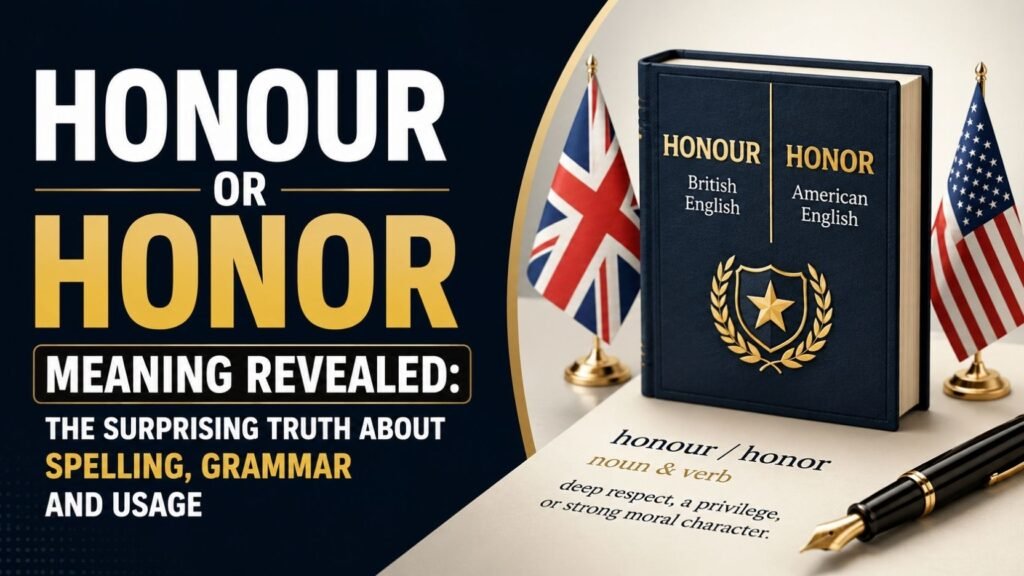
Honour and honor are the same word. Honour is the British spelling, and honor is the American spelling. Both refer to deep respect, a privilege, or strong moral character, and both are used as nouns and verbs in everyday English.
The spelling you choose depends on where you live or who you are writing for, not on the meaning. Americans, Canadians, and the British all use this word constantly, in speeches, wedding invitations, courtrooms, and daily conversation. Understanding both spellings helps you write correctly no matter which audience you are addressing.
What Does Honour or Honor Mean?
At its core, honour or honor means high respect or admiration given to someone or something. It can also describe a privilege, a person’s integrity, or an act of keeping a promise. The word carries several related meanings, and context usually makes clear which one is intended.
Here are the main meanings, explained separately so they are easy to tell apart.
Meaning 1: Deep respect or esteem
This is the most common meaning. It describes the admiration people feel for someone who has earned it through their actions, character, or achievements.
Example: The soldiers were remembered with honor for their courage.
Meaning 2: A privilege or special opportunity
Here, the word describes something valued because it does not happen often, or because it reflects trust or recognition.
Example: It was an honour to be invited to speak at the ceremony.
Meaning 3: Personal integrity or moral character
This meaning focuses on a person’s inner sense of right and wrong, and their commitment to doing what is fair and truthful.
Example: She kept her word out of honor, even when it cost her something.
Meaning 4: To fulfil or keep something (verb use)
As a verb, to honour or honor something means to carry it out as promised, such as an agreement, a commitment, or a tradition.
Example: The company will honor the original warranty terms.
See More: What Does OFC Mean In Texts?
Honour or Honor: The Spelling Difference
The meaning never changes between honour and honor. Only the spelling changes, and that depends on regional English conventions.
| Spelling | Region | Common Use |
| Honor | United States | Standard American English spelling |
| Honour | United Kingdom, Ireland | Standard British English spelling |
| Honour | Canada, Australia, New Zealand | Standard spelling, following British conventions |
Tip: If you are writing for a US audience, use honor. If you are writing for a UK, Canadian, Australian, or Irish audience, use honour. Business and academic writing should stay consistent with the target audience’s regional spelling.
This pattern is not unique to this word. Many English words that end in “our” in British English drop the “u” in American English, such as colour and color, favour and favor, and neighbour and neighbor. Honour and honor follow the exact same rule.
Honour or Honor Pronunciation
Both spellings are pronounced the same way. The letter “h” at the start is silent, which surprises many new English learners.
- American pronunciation: AH-ner (/ˈɑːnər/)
- British pronunciation: ON-uh (/ˈɒnər/)
The stress falls on the first syllable in both accents. Because the “h” is silent, the word sounds like it begins with a vowel. This is why people say “an honour” and not “a honour,” even though the word starts with a written consonant.
Common mistake: Saying the “h” sound at the beginning. Native speakers never pronounce it, in either American or British English.
Part of Speech and Grammar
Honour or honor works as both a noun and a verb, which makes it flexible in a sentence.
- As a noun, it names a thing: respect, privilege, or integrity.
- As a verb, it names an action: to respect, to keep a promise, or to recognize someone formally.
Grammar Table
| Form | Word | Function |
| Noun (singular) | Honour or Honor | Names the concept of respect or privilege |
| Noun (plural) | Honours or Honors | Refers to awards, distinctions, or academic degrees |
| Verb (base form) | Honour or Honor | To show respect or fulfil a promise |
| Verb (past tense) | Honoured or Honored | Completed action of showing respect or keeping a commitment |
| Verb (present participle) | Honouring or Honoring | Ongoing action |
| Adjective | Honourable or Honorable | Describes a person or action showing integrity |
Notice that the “u” appears or disappears consistently across every form. If you choose British spelling, keep the “u” in every related word. If you choose American spelling, drop it everywhere.
Honour Meaning and Sentences
Seeing the word used in real sentences makes the meaning clearer than a definition alone.
- It is a great honour to accept this award on behalf of my team.
- He served his country with honor for over twenty years.
- The university awarded her an honorary degree in recognition of her research.
- They named the scholarship in honour of their late professor.
- Please honor the terms stated in the contract.
- The committee will honour all requests submitted before the deadline.
Each sentence uses a slightly different meaning: respect, privilege, recognition, or fulfilling an agreement. The surrounding words usually make the intended meaning obvious.
What an Honour Meaning
The phrase “what an honour” is an exclamation. People say it when they want to express genuine gratitude or surprise at being recognized, invited, or included in something meaningful.
Example: “You want me to lead this project? What an honour!”
This phrase is informal but sincere. It signals that the speaker feels genuinely respected or valued by the opportunity, rather than simply being polite.
It Is an Honour for Me Meaning
“It is an honour for me” is a more formal way of saying that something makes the speaker feel respected, privileged, or grateful. People often use it in speeches, acceptance remarks, or written thank-you messages.
Example: “It is an honour for me to stand here today and accept this position.”
This phrase works well in professional or ceremonial settings. It expresses humility along with gratitude, which makes it common in award speeches, graduation remarks, and formal introductions.
✅ Correct: It is an honour for me to be part of this team.
❌ Incorrect: It is an honour for me being part of this team.
The second version breaks standard grammar because “for me” should be followed by an infinitive verb form (“to be”), not a gerund (“being”).
See More: OKG Meaning In Text
Honour Someone Meaning
To honour someone means to show them respect, often through a public gesture, award, tribute, or ceremony. This use of the word usually involves recognizing a person’s achievements, character, or service.
Example: The city decided to honour the retired firefighter with a public ceremony.
This meaning differs slightly from simply respecting someone privately. Honouring someone typically involves an outward action: a speech, an award, a memorial, or a formal statement of appreciation.
Your Honor Or Honour: Addressing A Judge
“Your Honor” (American spelling) or “Your Honour” (British spelling) is a formal title used to address a judge in a courtroom. It is a sign of respect for the judge’s position and authority.
Table: Court Address Forms
| Country | Term Used | Spelling |
| United States | Your Honor | American |
| United Kingdom | Your Honour, My Lord, or My Lady, depending on the court | British |
| Canada | Your Honour | British |
| Australia | Your Honour | British |
In the US, “Your Honor” is used consistently across state and federal courts. In the UK, the address can vary depending on the seniority of the judge and the type of court, but “Your Honour” remains common in county courts and certain other settings.
Honor Vs Honour On Wedding Invitations
Wedding invitations are one of the most common places people encounter both spellings, and the choice is often treated as a matter of formality rather than nationality.
Traditional wedding etiquette associates the phrase “the honour of your presence” with ceremonies held in a church or another religious space, while “the honor of your presence” is often used for less formal or secular ceremonies. This distinction is a long-standing etiquette convention rather than a strict grammar rule, and many American couples choose “honour” purely for its traditional, formal appearance, regardless of venue.
If the wedding takes place somewhere other than a house of worship, many etiquette guides recommend using “the pleasure of your company” instead of either spelling of honor or honour.
Tip: Whichever spelling you choose, stay consistent throughout the invitation suite. If you use “honour,” also use “favour” on response cards. If you use “honor,” use “favor.”
Origin Of Honour Or Honor
The word comes from Old French “honor” or “honur,” which itself came from the Latin word “honor” or “honos,” meaning esteem, dignity, or public office. Latin honor was closely tied to public reputation and civic respect in Roman society.
When the Normans brought French vocabulary into England after 1066, honour entered Middle English with the “u” spelling, following French convention. British English kept this spelling. American English later simplified many “our” endings to “or,” a change strongly influenced by Noah Webster’s 19th century efforts to standardize a distinct American spelling system. That is why honor, colour and color, and similar word pairs exist today.
Synonyms And Related Words
These words overlap with honour or honor but carry small differences in tone or emphasis.
| Word | Meaning | Difference From Honour or Honor |
| Respect | General regard or esteem for someone | Less formal, used more broadly in everyday situations |
| Prestige | Reputation based on success or status | Focuses on social standing rather than moral character |
| Integrity | Strong moral principles | Focuses on personal ethics rather than external recognition |
| Dignity | Calm, self-respecting behaviour | Describes composure and self-worth, not recognition from others |
| Privilege | A special right or advantage | Focuses on opportunity, not necessarily respect |
Honour or honor is broader than any single synonym. It can describe respect given by others, integrity held within a person, or a formal privilege, depending on context.
Common Mistakes With Honour or Honor
Even confident English speakers sometimes misuse this word. Here are frequent errors and the correct alternatives.
❌ Incorrect: I have an honor to meet you.
✅ Correct: I have the honour to meet you. (Or, more naturally: It is an honour to meet you.)
❌ Incorrect: She was honor by the award committee.
✅ Correct: She was honoured by the award committee.
❌ Incorrect: Mixing spellings in the same document, such as writing “honour” in one paragraph and “honor” in another.
✅ Correct: Choose one spelling convention and use it consistently throughout the entire piece of writing.
❌ Incorrect: Pronouncing the silent “h” at the start of the word.
✅ Correct: The “h” is always silent, in both American and British pronunciation.
Honour Spelling UK
In UK English, honour always keeps the “u.” This applies to the noun form and most related words, including honourable and honourably. However, some derived words drop the “u” even in British English, which often confuses learners.
Table: British Spelling Exceptions
| Word | UK Spelling | Reason |
| Honour | Honour | Standard British noun spelling |
| Honourable | Honourable | Keeps the “u” before a consonant suffix |
| Honorary | Honorary | Drops the “u” even in British English |
| Honorific | Honorific | Drops the “u” even in British English |
The rule is not perfectly consistent. Words like honorary and honorific lose the “u” in both American and British English, because the suffix pattern changed the spelling long before the American versus British split occurred. This is worth remembering, since assuming every derived word keeps the “u” in British English is a common mistake.
See More: YKW Meaning In Text
Frequently Asked Questions
What does honour or honor mean?
It means deep respect, a privilege, personal integrity, or the act of fulfilling a promise, depending on the context of the sentence.
Is honour a noun or a verb?
It works as both. As a noun, it names respect or privilege. As a verb, it means to show respect or to keep an agreement.
How do you pronounce honour or honor?
Both spellings are pronounced the same way, with a silent “h” and stress on the first syllable: AH-ner in American English, ON-uh in British English.
What is the difference between honor and honour?
There is no difference in meaning. Honor is the American spelling, and honour is the British, Canadian, and Australian spelling.
Why do Americans spell it honor instead of honour?
American English simplified many British “our” endings to “or” during the 19th century, largely due to Noah Webster’s efforts to create a distinct American spelling system.
Should wedding invitations use honor or honour?
Either spelling is acceptable. Many etiquette traditions associate “honour” with formal or religious ceremonies, but the final choice usually comes down to personal preference and overall invitation style.
Is honorable spelled with a u in British English?
Yes. British English uses honourable, keeping the “u,” while American English uses honorable, without it.
What is the correct way to address a judge? I
n American courts, judges are addressed as “Your Honor.” In the UK, Canada, and Australia, the address is typically “Your Honour,” though UK courts sometimes use other formal titles depending on the judge’s rank.
Conclusion
Honour and honor mean exactly the same thing. The word describes respect, a privilege, personal integrity, or the act of keeping a promise, and the only real difference between the two versions is regional spelling. Once you understand this, choosing between them becomes simple: use honor for American audiences, and honour for British, Canadian, or Australian audiences.
Whether you are writing a wedding invitation, addressing a judge, or thanking someone for an opportunity, the key is consistency. Pick one spelling and use it throughout your writing, and you will always use honour or honor correctly, no matter which version of English you are working in.

Sana Saleem is the author of Meanz Vault, dedicated to researching and writing about word meanings, slang meanings, name meanings and language. With 4 years of experience, his aim is to provide clear, accurate, and easy-to-understand information that helps readers discover the meaning behind words, phrases, and names.